Introduction
Artificial intelligence is evolving rapidly beyond traditional chatbots and question-answering systems.
Modern organisations increasingly require AI systems capable of reasoning, planning, retrieving information, interacting with software, and completing tasks autonomously. Rather than simply responding to prompts, businesses are seeking intelligent systems that can execute workflows, automate operations, and support decision-making with minimal human intervention.
This shift has led to the rise of AI agents.
Unlike conventional AI applications that generate responses based on individual prompts, AI agents can analyse objectives, retrieve relevant information, make decisions, interact with external tools, and perform multi-step actions to achieve specific outcomes. These capabilities enable organisations to automate increasingly complex processes while improving efficiency, accuracy, and scalability.
As enterprises explore automation, customer support, operations, research, compliance, and productivity use cases, AI agents are becoming one of the most important areas of modern AI development.
From intelligent customer service assistants and autonomous research agents to workflow automation platforms and enterprise knowledge systems, AI agents are transforming how organisations operate and interact with information.
However, building production-ready AI agents requires more than simply connecting a language model to a software application. Successful implementations depend on architecture design, memory systems, retrieval mechanisms, tool integrations, security controls, governance frameworks, and continuous evaluation.
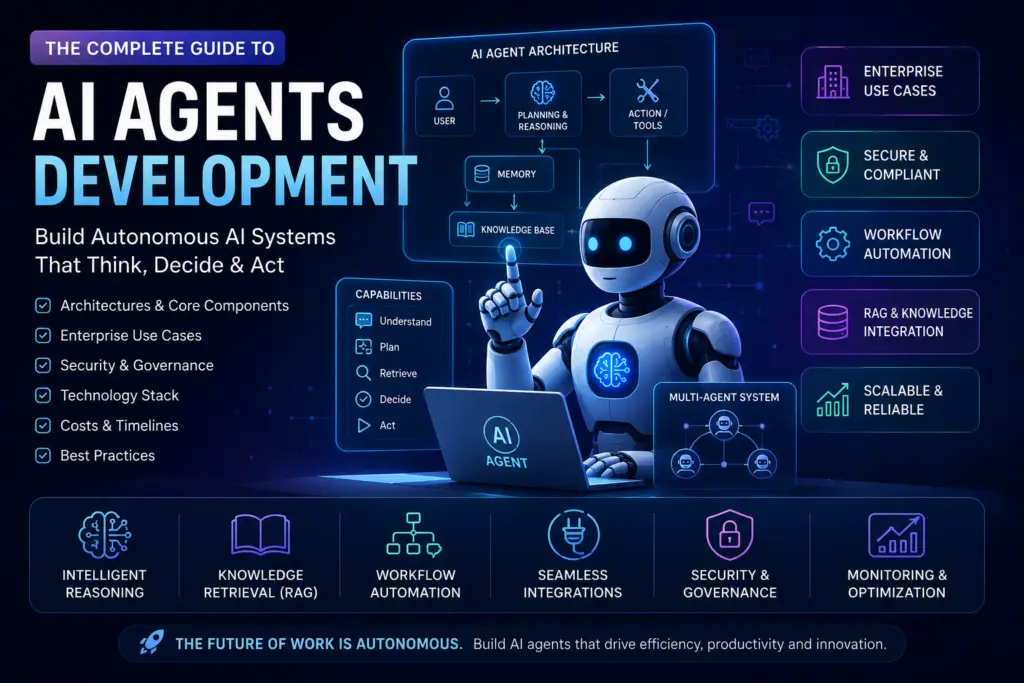
In this guide, we’ll explore how AI agents work, common architectures, enterprise use cases, development frameworks, security considerations, implementation costs, development timelines, and best practices for building autonomous AI systems in 2026.
Whether you’re a founder evaluating automation opportunities, a CTO planning enterprise AI initiatives, or a product team exploring intelligent software capabilities, this guide will provide a practical roadmap for understanding and implementing AI agents successfully.
What You’ll Learn
By the end of this guide, you’ll understand:
- What AI agents are and how they work
- How AI agents differ from traditional chatbots and AI assistants
- Core components of modern agent architectures
- Single-agent versus multi-agent systems
- Enterprise use cases for AI agents
- Security, governance, and compliance considerations
- AI agent development costs and timelines
- Common implementation mistakes
- How to choose the right AI Agents Development partner
What Are AI Agents?
AI agents are software systems capable of perceiving information, reasoning about objectives, making decisions, and taking actions to achieve specific goals.
Unlike traditional AI applications that simply generate responses, AI agents can interact with external systems, access knowledge repositories, call APIs, execute workflows, and adapt their behaviour based on changing situations.
A modern AI agent typically combines:
- Large language models (LLMs)
- Memory systems
- Retrieval mechanisms
- Tool integrations
- Decision-making logic
- Workflow execution capabilities
These components enable agents to operate with varying degrees of autonomy while remaining aligned with business objectives.
For example, a traditional chatbot may answer a customer question, whereas an AI agent can retrieve information, analyse the request, update records in a CRM system, send notifications, and complete a multi-step workflow without requiring continuous human intervention.
As organisations increasingly adopt automation and intelligent business processes, AI Agents Development is becoming a critical capability for enterprises seeking to improve productivity, reduce manual workloads, and enhance operational efficiency.
AI Agents vs Traditional Chatbots
Traditional chatbots have been used for many years to answer predefined questions and provide basic customer support. While these systems can be useful for simple interactions, they are often limited in their ability to reason, take actions, or adapt to changing situations.
AI agents represent a significant evolution beyond conventional chatbot technology.
The key difference is that chatbots primarily generate responses, while AI agents can make decisions, use tools, retrieve information, and execute tasks to achieve specific objectives.
| Feature | Traditional Chatbot | AI Agent |
|---|---|---|
| Responds to user questions | ✓ | ✓ |
| Uses external tools | Limited | ✓ |
| Retrieves enterprise knowledge | Limited | ✓ |
| Executes workflows | ✗ | ✓ |
| Multi-step reasoning | Limited | ✓ |
| Autonomous task completion | ✗ | ✓ |
| Integrates with business systems | Limited | ✓ |
For example, a chatbot might answer a customer’s question about an order status. An AI agent could retrieve order information, update shipping preferences, create support tickets, notify stakeholders, and provide a complete resolution within a single interaction.
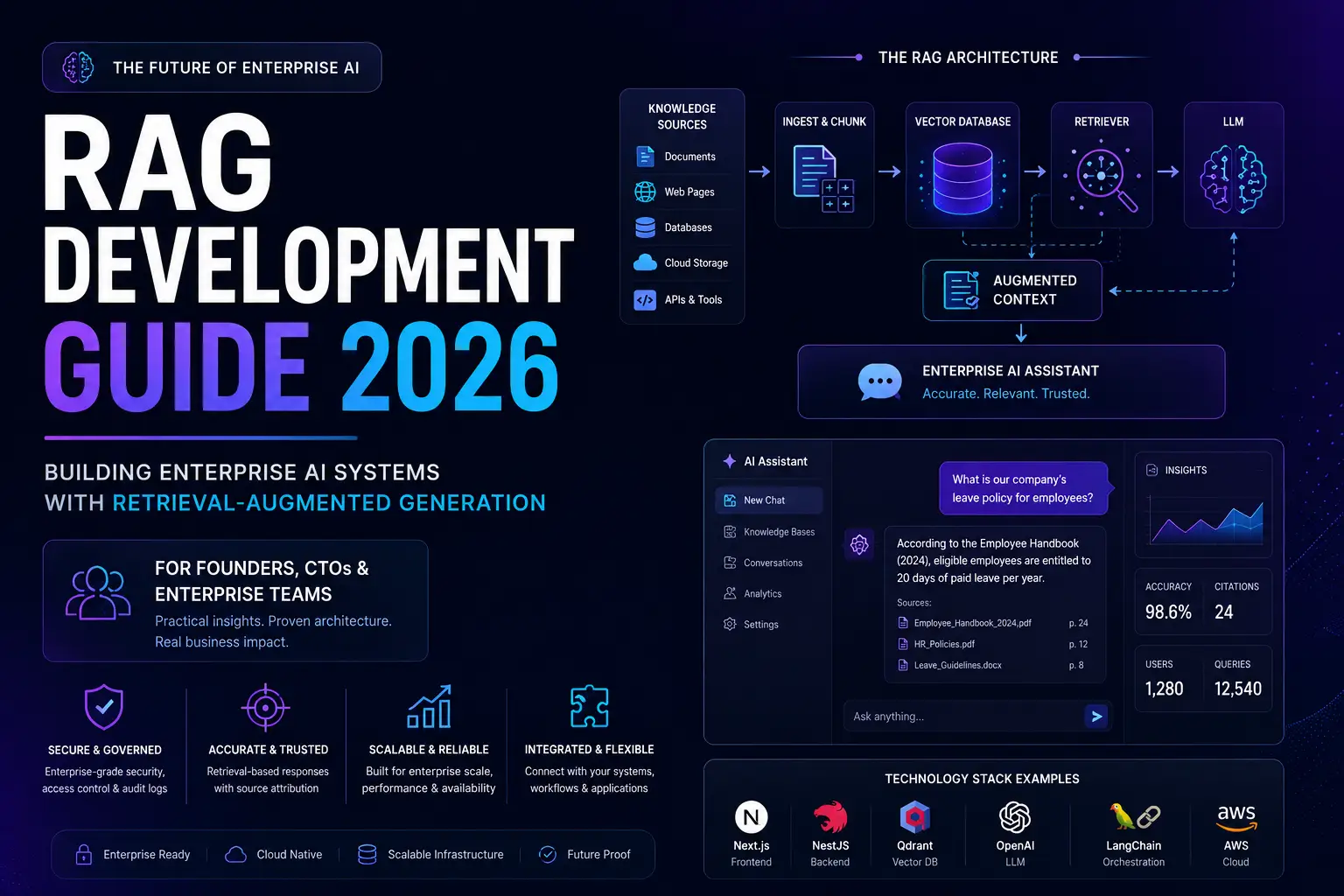
Many modern AI agents combine Retrieval-Augmented Generation (RAG), workflow automation, and large language models to create highly capable business systems.
This evolution is driving significant investment in enterprise AI Development initiatives as organisations seek to automate increasingly complex operational processes.
How AI Agents Work
At a high level, AI agents operate by combining reasoning, memory, retrieval, and action execution within a structured workflow.
Unlike traditional AI applications that generate responses based solely on a user’s prompt, AI agents continuously evaluate objectives, gather information, make decisions, and perform actions to achieve specific outcomes.
This enables agents to function as intelligent digital workers capable of completing tasks rather than simply answering questions.
The Basic AI Agent Workflow
Most AI agents follow a sequence of steps:
Receive an objective or task
Analyse the request
Retrieve relevant information
Determine the next action
Execute actions using available tools
Evaluate results
Continue until the objective is achieved
This iterative process allows agents to adapt their behaviour based on new information and changing circumstances.
Perception Layer
The first stage involves gathering information from various sources.
Depending on the use case, an agent may collect information from:
User prompts
Enterprise knowledge bases
Databases
APIs
Business applications
Internal documentation
Real-time data sources
The quality of information available to the agent often has a significant impact on overall performance.
Reasoning Layer
After gathering information, the agent evaluates available options and determines the most appropriate course of action.
The reasoning layer is responsible for:
Understanding objectives
Breaking down complex tasks
Planning actions
Prioritising activities
Making decisions
Modern large language models play an important role in enabling this reasoning capability.
Memory Layer
Many advanced AI agents maintain memory that enables them to retain context across interactions.
Memory may include:
Previous conversations
User preferences
Historical actions
Business context
Workflow state
Memory helps agents provide more consistent and personalised experiences over time.
Retrieval Layer
Enterprise AI agents frequently require access to organisational knowledge.
Rather than relying solely on model training data, agents often retrieve information from trusted knowledge sources before making decisions or generating responses.
This approach improves:
Accuracy
Relevance
Explainability
Trustworthiness
Many enterprise AI agents rely on Retrieval-Augmented Generation (RAG) architectures to support knowledge retrieval and contextual reasoning.
Tool Execution Layer
One of the most important characteristics of AI agents is their ability to use external tools.
Examples include:
CRM systems
Email platforms
Project management software
ERP systems
Databases
Search engines
Internal APIs
Instead of merely suggesting actions, agents can execute them directly when authorised.
Feedback and Evaluation
Effective AI agents continuously evaluate outcomes and adjust behaviour when necessary.
This may involve:
Verifying task completion
Assessing response quality
Detecting failures
Requesting additional information
Choosing alternative actions
This feedback loop enables agents to operate more reliably in real-world business environments.
Example: Customer Support Agent
Consider an AI customer support agent.
When a customer submits a request, the agent may:
Analyse the customer’s issue
Retrieve account information
Search internal knowledge bases
Check order status
Generate a recommended resolution
Update support records
Notify relevant teams
The agent completes a series of coordinated actions rather than simply generating a text response.
Why This Matters
The ability to reason, retrieve information, use tools, and execute workflows is what differentiates AI agents from traditional AI applications.
As organisations increasingly seek intelligent automation solutions, these capabilities are becoming essential for delivering measurable business value.
Understanding how AI agents work is therefore a foundational step in designing scalable and secure enterprise AI systems.
Core Components of an AI Agent Architecture
Modern AI agents are built from multiple interconnected components that work together to perceive information, reason about objectives, retrieve knowledge, make decisions, and execute actions.
While implementations vary depending on business requirements, most enterprise AI agents share a common architectural foundation.
Understanding these components helps organisations evaluate technology choices and design scalable AI systems that can operate reliably in real-world environments.
Large Language Model (LLM)
The large language model serves as the reasoning engine of the AI agent.
It enables the agent to:
Understand natural language
Interpret objectives
Generate responses
Plan actions
Analyse information
Make decisions
Popular model providers include:
OpenAI
Anthropic
Google
Meta
Mistral
The model selected often depends on performance requirements, security considerations, deployment preferences, and budget.
While the LLM provides reasoning capabilities, it is only one part of the overall agent architecture.
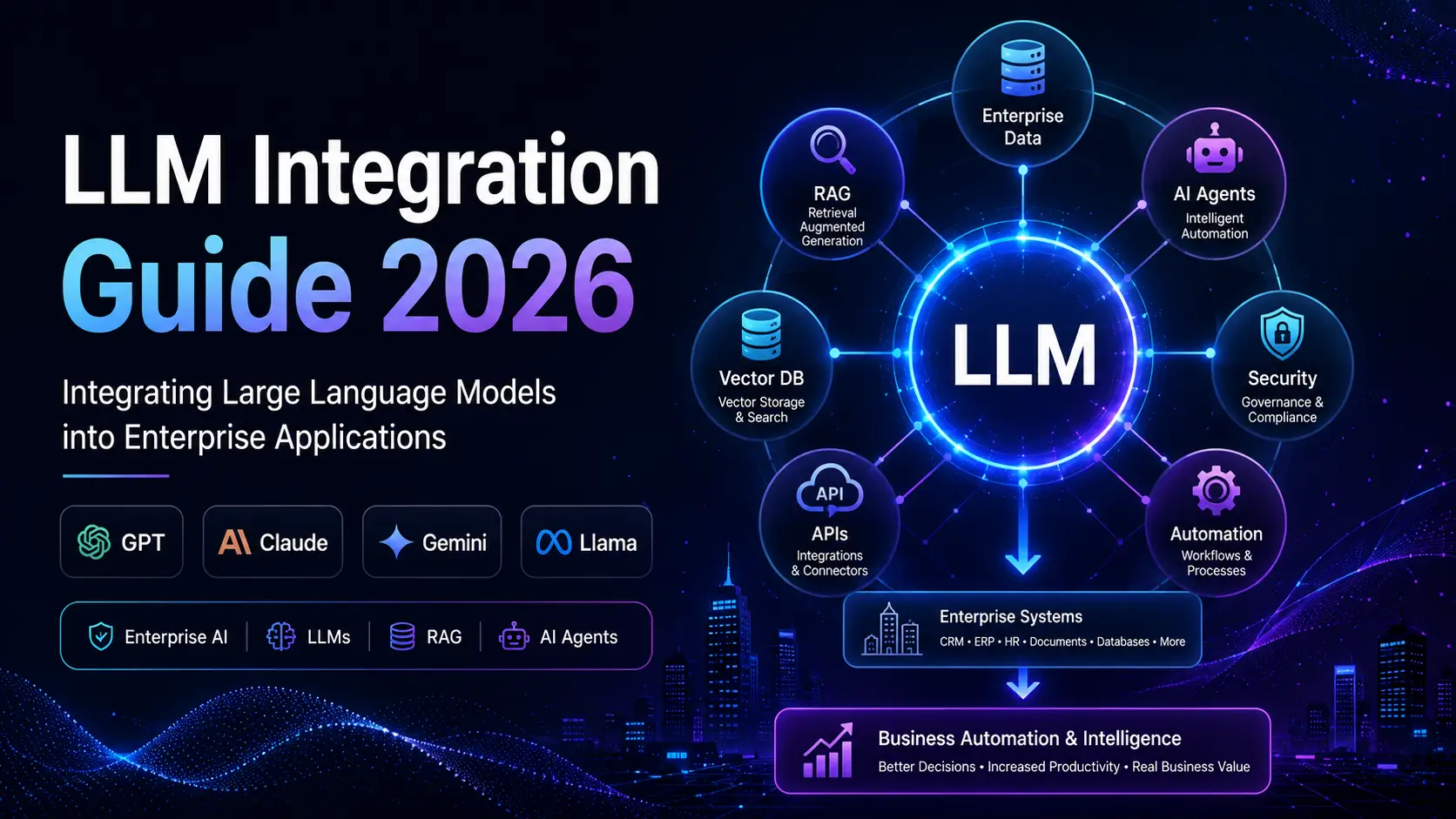
Effective LLM Integration is essential for ensuring reliable connectivity, governance, and performance across multiple AI model providers.
Memory Systems
Memory enables AI agents to retain information across interactions and workflows.
Without memory, an agent would treat every interaction as a completely new conversation.
Common forms of memory include:
Conversation history
User preferences
Workflow state
Historical actions
Business context
Memory allows agents to deliver more personalised, context-aware, and consistent experiences over time.
Retrieval Systems
Enterprise agents frequently need access to information that exists outside the language model.
Retrieval systems enable agents to search and retrieve information from:
Knowledge bases
Internal documentation
Databases
CRM platforms
Cloud storage systems
Business applications
Retrieval capabilities help improve accuracy while reducing reliance on static model training data.
Many enterprise AI agents use Retrieval-Augmented Generation (RAG) to provide access to trusted organisational knowledge.
Tool Integration Layer
One of the defining characteristics of AI agents is their ability to interact with external systems.
Tool integrations allow agents to:
Query databases
Send emails
Create support tickets
Update CRM records
Generate reports
Execute workflows
Trigger automation processes
These integrations transform AI from a conversational interface into an operational business capability.
Planning and Decision-Making Engine
Many advanced agents include planning capabilities that allow them to break complex objectives into smaller tasks.
The planning layer helps agents:
Analyse goals
Prioritise actions
Determine execution sequences
Evaluate alternatives
Adapt to changing conditions
This capability is particularly important for enterprise workflows that involve multiple steps and decision points.
Orchestration Layer
The orchestration layer coordinates interactions between all architectural components.
Responsibilities often include:
Workflow management
Context handling
Tool selection
Memory coordination
Retrieval execution
Error handling
As AI agents become more sophisticated, orchestration becomes increasingly important for maintaining reliability and scalability.
Security and Governance Controls
Enterprise AI agents must operate within defined security and governance frameworks.
Common controls include:
Authentication
Access management
Role-based permissions
Audit logging
Data encryption
Compliance policies
Security should be embedded throughout the architecture rather than treated as an isolated feature.
Monitoring and Evaluation
Production AI agents require continuous monitoring to ensure quality and reliability.
Key metrics often include:
Task completion rates
Response quality
Retrieval accuracy
Tool execution success
User satisfaction
System performance
Monitoring helps organisations identify issues, improve performance, and maintain trust in AI systems.
How These Components Work Together
A typical enterprise AI agent might:
Receive a business request
Retrieve relevant information
Analyse available options
Create an execution plan
Use external tools
Complete actions
Store relevant context in memory
Report results to the user
Each component contributes to the agent’s ability to operate autonomously while remaining aligned with business objectives.
Building Enterprise-Grade AI Agents
Successful AI agents are rarely powered by a language model alone.
The most effective systems combine reasoning, retrieval, memory, planning, orchestration, security, and monitoring into a unified architecture.
As enterprise adoption continues to grow, organisations investing in broader AI Development initiatives should focus on building architectures that balance intelligence, reliability, governance, and scalability.
A well-designed architecture provides the foundation for creating autonomous systems capable of delivering meaningful business value across a wide range of enterprise use cases.
Single-Agent vs Multi-Agent Systems
As AI agent technology continues to evolve, organisations are increasingly evaluating different architectural approaches for automation and intelligent decision-making.
One of the most important design considerations is whether to deploy a single-agent system or a multi-agent system.
While both approaches can deliver significant business value, they serve different purposes and are suited to different levels of complexity.
Understanding the strengths and trade-offs of each model can help organisations make more informed architectural decisions.
What Is a Single-Agent System?
A single-agent system consists of one AI agent responsible for understanding objectives, retrieving information, making decisions, and executing actions.
The agent acts as a central coordinator for all activities within the workflow.
Typical responsibilities may include:
Answering questions
Retrieving information
Executing tasks
Interacting with software systems
Managing workflow execution
Single-agent systems are often easier to design, deploy, and maintain.
They are particularly effective for focused business use cases where workflows remain relatively straightforward.
Advantages of Single-Agent Systems
Benefits include:
Simpler architecture
Faster implementation
Lower operational complexity
Easier monitoring and governance
Reduced infrastructure requirements
For many organisations, a single-agent architecture provides sufficient capability during the early stages of AI adoption.
Common Single-Agent Use Cases
Examples include:
Customer support assistants
Internal knowledge assistants
Employee helpdesk systems
Sales support tools
Document search platforms
Workflow automation assistants
These systems typically operate effectively without requiring multiple specialised agents.
What Is a Multi-Agent System?
A multi-agent system consists of multiple AI agents working together to achieve a shared objective.
Rather than relying on a single agent to perform every task, responsibilities are distributed across specialised agents.
Each agent may focus on a specific domain or capability.
Examples include:
Research agents
Planning agents
Retrieval agents
Compliance agents
Reporting agents
Workflow execution agents
This division of responsibilities can improve scalability, flexibility, and problem-solving capabilities.
How Multi-Agent Systems Work
A typical multi-agent workflow may operate as follows:
A coordinator agent receives a request
A retrieval agent gathers relevant information
A research agent analyses findings
A planning agent determines next steps
An execution agent performs required actions
A reporting agent generates results
Each specialised agent contributes to the overall objective while focusing on its area of expertise.
Advantages of Multi-Agent Systems
Benefits often include:
Better scalability
Improved task specialisation
Greater flexibility
Enhanced reasoning capabilities
Support for complex workflows
Improved separation of responsibilities
These characteristics make multi-agent architectures increasingly attractive for enterprise environments.
Challenges of Multi-Agent Systems
While powerful, multi-agent architectures also introduce additional complexity.
Potential challenges include:
Increased infrastructure requirements
Higher development costs
Agent coordination complexity
Additional monitoring requirements
Governance considerations
Security management
Organisations should carefully evaluate whether the benefits justify the additional complexity.
Single-Agent vs Multi-Agent Comparison
| Feature | Single-Agent | Multi-Agent |
|---|---|---|
| Architecture Complexity | Low | High |
| Development Speed | Faster | Slower |
| Operational Complexity | Lower | Higher |
| Scalability | Moderate | High |
| Task Specialisation | Limited | Strong |
| Workflow Flexibility | Moderate | High |
| Enterprise Suitability | Good | Excellent for Complex Systems |
Which Approach Should You Choose?
The answer depends on business requirements.
For many organisations, a single-agent architecture is the best starting point.
It allows teams to:
Validate business value
Reduce implementation risk
Improve operational understanding
Accelerate deployment
As requirements grow, organisations can gradually introduce additional specialised agents.
This phased approach often produces stronger outcomes than attempting to deploy a complex multi-agent system from the beginning.
The Rise of Agentic AI
Recent advances in large language models, retrieval systems, and workflow orchestration have accelerated interest in agentic AI architectures.
These systems combine reasoning, memory, retrieval, planning, and execution capabilities to create increasingly autonomous software systems.
Many enterprise deployments also incorporate Retrieval-Augmented Generation (RAG) architectures to provide agents with access to trusted organisational knowledge and real-time business information.
Many enterprise AI initiatives are now exploring multi-agent architectures to support complex business operations, research workflows, compliance processes, and intelligent automation programmes.
Building the Right Architecture
There is no universal architecture that fits every organisation.
The most successful AI Agents Development projects align architectural decisions with business objectives, operational requirements, governance needs, and long-term scalability goals.
Whether deploying a single-agent assistant or a sophisticated multi-agent ecosystem, the focus should remain on delivering measurable business value while maintaining security, reliability, and operational control.
As enterprise AI adoption continues to mature, both single-agent and multi-agent systems will play important roles in shaping the future of intelligent automation.
Enterprise Use Cases for AI Agents
The rapid adoption of AI agents is being driven by practical business outcomes rather than technology trends alone.
Organisations are increasingly deploying AI agents to automate repetitive tasks, improve productivity, enhance customer experiences, and support decision-making across multiple departments.
Unlike traditional automation tools that rely on predefined workflows, AI agents can reason, retrieve information, adapt to changing conditions, and execute actions autonomously.
These capabilities make them particularly valuable for enterprise environments where efficiency, scalability, and operational agility are critical.
Below are some of the most common enterprise use cases for AI Agents in 2026.
Customer Support and Service Automation
Customer support remains one of the most popular applications for AI agents.
Modern support agents can:
Answer customer enquiries
Retrieve account information
Search knowledge bases
Create support tickets
Escalate complex issues
Provide personalised assistance
Unlike traditional chatbots, AI agents can complete actions and resolve problems rather than simply providing information.
This helps organisations improve customer satisfaction while reducing operational workloads.
Internal Knowledge Assistants
Employees often spend significant time searching for information spread across multiple systems.
AI-powered knowledge assistants can help teams quickly access:
Company policies
Internal procedures
Product documentation
Training materials
Project information
Technical resources
By combining retrieval capabilities with reasoning, these systems improve knowledge discovery and employee productivity.
Many organisations integrate Retrieval-Augmented Generation (RAG) architectures to ensure responses are grounded in trusted organisational knowledge.
Sales and Revenue Operations
Sales teams manage large volumes of information and administrative activities.
AI agents can assist by:
Researching prospects
Summarising customer interactions
Updating CRM records
Generating sales insights
Drafting follow-up communications
Identifying sales opportunities
This enables sales professionals to focus more time on relationship building and revenue generation.
Human Resources and Talent Management
HR teams are increasingly using AI agents to streamline internal operations.
Common use cases include:
Employee onboarding
Policy assistance
Benefits information
Recruitment support
Training recommendations
Internal helpdesk services
AI agents can improve employee experiences while reducing administrative workloads.
Compliance and Regulatory Support
Industries operating within regulated environments often manage extensive documentation and governance requirements.
AI agents can assist with:
Policy retrieval
Regulatory research
Audit preparation
Compliance monitoring
Documentation review
Knowledge discovery
Because responses can be grounded in approved information sources, organisations can improve efficiency while maintaining governance controls.
IT Service Management
Technology teams frequently handle repetitive support requests and operational tasks.
AI agents can support:
IT helpdesks
Incident response
Knowledge retrieval
Troubleshooting assistance
Access request workflows
System monitoring
This helps reduce support volumes while improving service delivery.
Research and Business Intelligence
Research activities often require gathering information from multiple sources and analysing large volumes of data.
AI agents can:
Conduct research
Summarise findings
Identify trends
Compare information
Generate reports
Support decision-making
These capabilities enable organisations to accelerate analysis and improve access to actionable insights.
Financial Services and Operations
Financial institutions are increasingly exploring AI agent architectures for:
Customer service
Risk analysis
Regulatory research
Internal knowledge management
Workflow automation
Operational support
Security, governance, and auditability remain particularly important in these environments.
Healthcare and Clinical Support
Healthcare organisations manage large volumes of operational and clinical information.
AI agents can assist with:
Knowledge retrieval
Administrative workflows
Policy access
Staff support
Training resources
Information management
Healthcare deployments typically require strict security controls and regulatory compliance.
AI-Powered SaaS Products
Many software companies are embedding AI agents directly into their products.
Examples include:
Product copilots
Customer success assistants
Intelligent onboarding systems
Workflow automation tools
Enterprise search capabilities
These features help improve user experiences while creating additional product value.
Many modern AI SaaS Development projects now include AI agent capabilities as a core component of their platform strategy.
Executive and Decision Support Systems
Business leaders often need access to information distributed across multiple systems and departments.
AI agents can assist executives by:
Summarising reports
Gathering operational insights
Monitoring key metrics
Retrieving business information
Supporting strategic decision-making
This enables leaders to access critical information more efficiently and make faster decisions.
Why Enterprise Adoption Is Accelerating
The demand for intelligent automation continues to grow across industries.
Organisations are increasingly recognising that AI agents can automate tasks that previously required significant human effort while maintaining flexibility and adaptability.
As AI capabilities mature, enterprises are moving beyond simple chat interfaces and deploying systems capable of reasoning, planning, retrieving information, and executing actions autonomously.
This shift is driving significant investment in AI Agents Development as organisations seek to improve productivity, reduce operational costs, and create more scalable business processes.
The result is a new generation of enterprise software powered by intelligent agents that can support users, automate workflows, and help organisations operate more efficiently.
Designing Secure Enterprise AI Agents
As organisations deploy increasingly autonomous AI systems, security becomes one of the most important considerations in modern AI Development, particularly when agents interact with sensitive business information and critical workflows.
Unlike traditional software applications, AI agents can retrieve information, interact with business systems, execute workflows, and make decisions that may directly impact operations.
While these capabilities create significant business value, they also introduce new security, governance, and compliance challenges.
Enterprise organisations must therefore ensure that AI agents operate within clearly defined boundaries while maintaining transparency, accountability, and control.
Security should not be treated as a feature added after deployment. It should be embedded into the architecture from the earliest stages of development.
Identity and Authentication
Every enterprise AI agent should operate within a trusted identity framework.
Authentication mechanisms help verify user identities before granting access to systems, knowledge repositories, and business applications.
Common approaches include:
Single Sign-On (SSO)
Multi-Factor Authentication (MFA)
OAuth
SAML
Enterprise Identity Providers
Strong authentication controls help ensure that only authorised users can interact with AI systems and access protected information.
Role-Based Access Control (RBAC)
Not every user should have access to the same capabilities or information.
Role-based access controls allow organisations to define permissions based on responsibilities and organisational roles.
Examples include:
Employees
Team Leaders
Human Resources
Finance Teams
Legal Departments
Executive Leadership
AI agents should respect existing permission structures and never expose information beyond a user’s authorised scope.
Securing Enterprise Knowledge Access
Many AI agents rely on enterprise knowledge sources to answer questions and support decision-making.
These knowledge sources may contain:
Internal documentation
Financial information
Legal records
Customer data
Operational procedures
Strategic plans
Agents should only retrieve and expose information that users are authorised to access.
This becomes particularly important when AI agents are integrated with Retrieval-Augmented Generation (RAG) systems.
Tool and API Security
One of the defining characteristics of AI agents is their ability to interact with external tools and business systems.
Examples include:
CRM platforms
ERP systems
Email services
Project management tools
Internal APIs
Databases
Without proper safeguards, agents may execute unintended or unauthorised actions.
Best practices include:
API permission controls
Action approval workflows
Transaction limits
Audit trails
Human oversight for critical actions
These controls help reduce operational risk while maintaining automation capabilities.
Protecting Sensitive Information
Enterprise environments often manage sensitive information that requires additional protection.
Examples include:
Personally identifiable information (PII)
Customer records
Employee information
Financial data
Intellectual property
Confidential business documents
AI agents should incorporate mechanisms such as:
Data masking
Access restrictions
Encryption
Query filtering
Output validation
These safeguards help reduce the risk of accidental information disclosure.
Audit Logging and Accountability
Autonomous systems must remain accountable.
Comprehensive audit logging enables organisations to track:
User interactions
Agent decisions
Tool usage
Retrieved documents
Workflow execution
Administrative changes
Detailed logs support governance, compliance, security investigations, and operational monitoring.
Human-in-the-Loop Controls
Not every decision should be fully automated.
Many organisations implement human-in-the-loop workflows for high-risk activities such as:
Financial approvals
Contract modifications
Compliance actions
Sensitive communications
Operational changes
Human oversight provides an additional layer of security and helps maintain organisational control.
Governance and Compliance
Enterprise AI deployments increasingly operate within regulated environments.
Examples include:
Financial Services
Healthcare
Insurance
Legal Services
Government Agencies
A secure AI agent architecture should support:
Governance policies
Compliance reporting
Access reviews
Data retention controls
Risk management processes
Strong governance frameworks help organisations deploy AI responsibly while meeting regulatory obligations.
Defending Against AI-Specific Threats
AI agents face security risks that differ from traditional software systems.
Examples include:
Prompt injection attacks
Data poisoning
Unauthorised tool usage
Sensitive data leakage
Model manipulation attempts
Organisations should implement monitoring, validation, and security testing processes to identify and mitigate these risks.
Building Trust Through Security
Enterprise adoption depends heavily on trust.
Users must feel confident that AI agents operate securely, respect access controls, and remain aligned with organisational policies.
The most successful enterprise AI deployments combine automation with governance, security, transparency, and accountability.
As organisations continue investing in AI Agents Development, security will remain a critical factor influencing adoption, operational success, and long-term business value.
A secure AI agent is not simply an intelligent system—it is a trusted system that can operate safely within the boundaries defined by the organisation.
AI Agent Development Technology Stack
Building production-ready AI agents requires more than selecting a language model.
Enterprise AI agents rely on multiple technologies working together to support reasoning, memory, retrieval, workflow execution, security, monitoring, and scalability.
The technology stack chosen can significantly influence development speed, operational reliability, security, and long-term maintainability.
While technology choices vary based on project requirements, most modern AI agent platforms share several common architectural layers.
Large Language Models
Large language models serve as the reasoning engine of AI agents.
These models enable agents to:
Understand user requests
Interpret objectives
Generate responses
Analyse information
Make decisions
Plan actions
Popular model providers include:
OpenAI
Anthropic
Google
Meta
Mistral
The optimal model depends on business requirements, security needs, performance expectations, and deployment preferences.
Effective LLM Integration is essential for ensuring reliable connectivity, governance, model management, and scalability across multiple AI providers.
Many enterprise platforms support multiple providers to improve flexibility and resilience.
Agent Orchestration Frameworks
As AI agents become more sophisticated, orchestration frameworks help manage workflows and coordinate interactions between different components.
Popular frameworks include:
LangChain
LangGraph
LlamaIndex
Haystack
CrewAI
AutoGen
These frameworks support:
Tool execution
Workflow management
Agent collaboration
State management
Memory handling
Multi-step reasoning
Orchestration is particularly important for enterprise agents that perform complex tasks across multiple systems.
Retrieval and Knowledge Systems
Many enterprise AI agents require access to organisational knowledge.
Retrieval systems enable agents to access:
Internal documentation
Knowledge bases
CRM systems
Databases
Operational records
Business applications
Retrieval capabilities improve response quality while ensuring agents can access current information.
Many enterprise AI agents integrate Retrieval-Augmented Generation (RAG) architectures to support knowledge retrieval and contextual reasoning.
Vector Database Layer
Vector databases store embeddings and support semantic search operations.
Popular technologies include:
Pinecone
Qdrant
Weaviate
Milvus
pgvector
These platforms enable agents to retrieve relevant information based on meaning rather than exact keyword matches.
Vector databases are often a critical component of enterprise knowledge systems.
Memory Infrastructure
Memory systems enable agents to maintain context across interactions and workflows.
Common memory types include:
Short-term memory
Long-term memory
Conversation history
Workflow state
User preferences
Operational context
Memory significantly improves the consistency and effectiveness of AI agents.
Backend Application Layer
The backend layer manages business logic, APIs, integrations, security controls, and workflow execution.
Common backend technologies include:
NestJS
Node.js
Python
FastAPI
.NET
Typical responsibilities include:
Authentication
Access control
Workflow orchestration
Tool management
Audit logging
Integration services
A well-designed backend architecture provides the foundation for secure and scalable AI agent deployments.
Frontend Experience Layer
Users typically interact with AI agents through web applications, portals, dashboards, and conversational interfaces.
Popular frontend technologies include:
Next.js
React
TypeScript
Tailwind CSS
The user experience layer should prioritise:
Accessibility
Responsiveness
Source transparency
Ease of use
Enterprise usability
An effective interface helps improve adoption and overall user satisfaction.
Workflow Automation Platforms
Many enterprise agents interact with workflow automation systems.
Common integrations include:
CRM platforms
ERP systems
Ticketing platforms
Project management tools
Communication platforms
Internal business applications
These integrations enable agents to perform actions rather than simply generate responses.
Security and Governance Layer
Enterprise deployments require strong security controls throughout the technology stack.
Common components include:
Single Sign-On (SSO)
Multi-Factor Authentication (MFA)
Role-Based Access Control (RBAC)
Encryption
Audit logging
Compliance controls
Security should be integrated into every architectural layer rather than treated as a standalone feature.
Monitoring and Observability
Production AI systems require continuous monitoring and evaluation.
Important metrics often include:
Task completion rates
Agent performance
Tool execution success
Retrieval quality
User satisfaction
System availability
Monitoring helps organisations identify issues, improve reliability, and maintain trust in AI systems.
A Typical Enterprise AI Agent Stack
A common enterprise deployment may include:
Next.js for frontend applications
NestJS for backend services
OpenAI or Anthropic models
LangGraph or LangChain for orchestration
Qdrant or Pinecone for vector search
PostgreSQL for operational data
Cloud infrastructure for scalability and resilience
This combination provides a strong foundation for building secure, scalable, and production-ready AI agents.
Choosing the Right Technology Stack
Technology decisions should be driven by business objectives rather than industry trends.
Factors to consider include:
Security requirements
Compliance obligations
Scalability expectations
Infrastructure expertise
Budget constraints
Existing technology investments
The most effective AI agent platforms are those that align technical architecture with long-term business goals.
As enterprise adoption continues to accelerate, organisations investing in AI Agents Development should prioritise technology stacks that support security, governance, reliability, and future scalability.
AI Agent Development Cost
One of the most common questions organisations ask when evaluating AI initiatives is:
“How much does AI agent development cost?”
The answer depends on several factors, including agent complexity, workflow requirements, integrations, security controls, deployment architecture, and the level of autonomy required.
A simple internal assistant may be relatively inexpensive to develop, while a sophisticated enterprise platform capable of orchestrating workflows across multiple systems can require a significantly larger investment.
Understanding the major cost drivers can help organisations plan budgets more effectively and make informed technology decisions.
Factors That Influence AI Agent Development Cost
Several variables influence the total cost of an AI agent project.
Common considerations include:
Number of integrations
Workflow complexity
Agent autonomy level
Security requirements
Compliance obligations
Knowledge retrieval requirements
Multi-agent architecture requirements
Infrastructure and hosting
Monitoring and observability
User volume and scalability requirements
Projects involving regulated industries or mission-critical workflows generally require additional engineering effort and governance controls.
Proof of Concept (PoC)
Many organisations begin with a proof of concept to validate business value and technical feasibility.
Typical objectives include:
Demonstrating agent capabilities
Validating use cases
Testing integrations
Evaluating user adoption
Measuring business impact
Proof-of-concept projects are typically limited in scope and focus on a single workflow or business problem.
Typical investment:
USD 5,000 – USD 15,000
Typical timeline:
2–4 weeks
MVP AI Agent Platform
An MVP introduces production-oriented capabilities while maintaining a focused feature set.
Typical features include:
Conversational interface
Basic memory
Knowledge retrieval
Workflow execution
Limited integrations
User authentication
The objective is to create a usable platform that can be evaluated by real users.
Typical investment:
USD 15,000 – USD 40,000
Typical timeline:
4–8 weeks
Enterprise Workflow Automation Agent
As organisations expand adoption, agents often become integrated into operational workflows.
Common capabilities include:
CRM integrations
ERP integrations
Knowledge management systems
Workflow automation
Multi-step task execution
Security and governance controls
Reporting and analytics
Many enterprise deployments also incorporate Retrieval-Augmented Generation (RAG) architectures to provide agents with access to trusted organisational knowledge and real-time business information.
Typical investment:
USD 40,000 – USD 100,000+
Typical timeline:
2–4 months
Multi-Agent Enterprise Platform
Large-scale enterprise deployments frequently involve multiple specialised agents working together across departments and business functions.
Capabilities may include:
Multi-agent orchestration
Advanced planning systems
Knowledge retrieval frameworks
Compliance controls
Human-in-the-loop workflows
Enterprise integrations
High-availability infrastructure
Advanced monitoring and governance
Typical investment:
USD 100,000 – USD 500,000+
Typical timeline:
4–12+ months
Infrastructure and Operational Costs
Development costs represent only part of the overall investment.
Organisations should also consider ongoing operational expenses, including:
AI model usage
Cloud infrastructure
Vector database hosting
Monitoring services
Security tooling
Storage costs
Maintenance and support
Operational costs vary significantly depending on usage volume, deployment architecture, and the complexity of agent workflows.
Build vs Buy Considerations
Some organisations evaluate off-the-shelf AI agent platforms before pursuing custom development.
Managed solutions may reduce implementation effort but often introduce limitations related to:
Customisation
Security controls
Data ownership
Workflow flexibility
Integration capabilities
Vendor dependency
Custom AI Agents Development typically requires a larger initial investment but provides greater long-term flexibility and control.
Cost Optimisation Strategies
Organisations can often reduce implementation costs by:
Starting with a focused use case
Prioritising high-value workflows
Implementing in phases
Reusing existing infrastructure
Validating business value early
Expanding incrementally
A phased delivery model frequently produces stronger outcomes than attempting to automate every process simultaneously.
Measuring Return on Investment
The value of an AI agent should not be measured solely by development cost.
Successful deployments often generate returns through:
Reduced manual effort
Faster workflow execution
Improved employee productivity
Better customer experiences
Lower operational costs
Increased scalability
For many organisations, these benefits can significantly outweigh the initial investment over time.
Investing in Intelligent Automation
AI agents are rapidly becoming part of the core technology infrastructure supporting modern business operations.
Many organisations now view AI agents as strategic investments within broader AI Development initiatives designed to improve productivity and operational efficiency.
As organisations continue investing in automation, intelligent workflows, and enterprise AI capabilities, the focus should be on building systems that deliver measurable business value while remaining secure, scalable, and maintainable.
For businesses evaluating AI Agents Development, the objective should be to create a long-term automation platform that supports future growth rather than simply minimising upfront development costs.
Development Timeline
One of the most common questions organisations ask when planning an AI initiative is:
“How long will it take to build and deploy an enterprise AI agent?”
The answer depends on several factors, including workflow complexity, integration requirements, security controls, governance requirements, and the level of autonomy expected from the agent.
A simple internal assistant can often be delivered relatively quickly, while enterprise-grade AI agent platforms that integrate with multiple business systems require significantly more planning, development, testing, and operational preparation.
Successful organisations typically follow a phased implementation approach that reduces risk while enabling continuous improvement over time.
Phase 1: Discovery and Planning
Every successful AI agent project begins with understanding business objectives and defining success criteria.
Typical activities include:
Stakeholder workshops
Use case identification
Process analysis
Workflow mapping
Security assessment
Architecture planning
Technology selection
The goal is to ensure the solution aligns with business priorities before development begins.
Typical duration:
1–3 weeks
Phase 2: Knowledge and Data Preparation
Many AI agents depend on access to business knowledge, operational information, and enterprise systems.
This phase may include:
Knowledge source assessment
Data quality analysis
Content classification
Metadata review
Governance planning
Access control mapping
Well-prepared knowledge sources often have a significant impact on the effectiveness of the final system.
Typical duration:
1–4 weeks
Phase 3: Architecture and Infrastructure Setup
The next phase focuses on establishing the technical foundation of the platform.
Activities commonly include:
Cloud infrastructure deployment
Database configuration
Security setup
Identity management integration
Development environment preparation
Monitoring infrastructure
A strong architectural foundation improves scalability, maintainability, and operational reliability.
Typical duration:
1–3 weeks
Phase 4: Core AI Agent Development
This is typically the largest phase of the project.
Development activities often include:
Agent workflow design
Tool integrations
Memory implementation
Retrieval systems
LLM integration
Backend development
Frontend interfaces
API development
The complexity of this phase varies significantly depending on the number of integrations and workflows involved.
Typical duration:
4–10 weeks
Phase 5: Security and Governance Implementation
Enterprise AI systems require strong security controls and governance frameworks.
Activities may include:
Authentication integration
Role-based access controls
Audit logging
Encryption implementation
Compliance controls
Permission validation
Security testing
Security validation is particularly important for agents that access sensitive information or execute business actions.
Typical duration:
1–4 weeks
Phase 6: Testing and Evaluation
Before deployment, organisations should thoroughly evaluate system performance and reliability.
Testing activities often include:
Workflow validation
Retrieval accuracy testing
Tool execution testing
Security assessment
User acceptance testing
Performance testing
This phase helps identify issues before the platform reaches production users.
Typical duration:
2–4 weeks
Phase 7: Deployment and Rollout
The final phase focuses on operational readiness and user adoption.
Activities may include:
Production deployment
Monitoring setup
User onboarding
Training sessions
Support preparation
Performance monitoring
A structured rollout strategy helps improve adoption while reducing operational risk.
Typical duration:
1–3 weeks
Typical Project Timelines
While every organisation has unique requirements, the following ranges are common.
Proof of Concept
A focused implementation designed to validate business value and technical feasibility.
Estimated timeline: 2–6 weeks
MVP AI Agent Platform
A production-oriented deployment with core functionality and limited integrations.
Estimated timeline: 1–3 months
Enterprise Workflow Automation Platform
A more advanced implementation supporting multiple workflows, integrations, and governance controls.
Estimated timeline: 3–6 months
Enterprise Multi-Agent Platform
A large-scale deployment involving multiple specialised agents, advanced orchestration, and enterprise-wide adoption.
Estimated timeline: 6–12+ months
Factors That Influence Timelines
Several factors can accelerate or extend project schedules.
Common considerations include:
Number of integrations
Workflow complexity
Security requirements
Compliance obligations
Data quality
Knowledge availability
User access requirements
Infrastructure architecture
Projects involving regulated industries or complex enterprise systems often require additional planning and validation.
Why a Phased Approach Works Best
Many organisations attempt to automate too much too quickly.
In practice, phased implementation typically produces stronger outcomes.
A phased approach allows organisations to:
Validate business value early
Gather user feedback
Improve workflows incrementally
Reduce implementation risk
Scale confidently
This strategy is widely used in successful AI Agents Development programmes because it balances innovation with operational stability.
Building for Long-Term Success
The objective of an AI agent initiative should not simply be to launch quickly.
Long-term success depends on creating a secure, scalable, and maintainable platform that can evolve alongside business requirements.
Organisations that invest in planning, governance, security, and continuous optimisation are often better positioned to realise sustainable value from intelligent automation initiatives.
As enterprise adoption continues to accelerate, realistic timelines and structured implementation strategies remain essential for delivering successful AI agent deployments.
Common Mistakes in AI Agent Development
AI agents offer significant opportunities for automation, productivity, and operational efficiency.
However, despite growing interest in agent-based systems, many projects fail to achieve their intended outcomes.
In most cases, the underlying technology is not the problem.
Instead, challenges often arise from unrealistic expectations, poor planning, weak governance, insufficient security controls, or attempts to automate processes that are not ready for automation.
Understanding these common mistakes can help organisations reduce implementation risks and improve the likelihood of long-term success.
Treating AI Agents as Advanced Chatbots
One of the most common misconceptions is assuming that AI agents are simply more sophisticated chatbots.
While conversational interfaces may be part of the solution, enterprise AI agents typically involve:
Workflow automation
Decision-making logic
Tool integrations
Knowledge retrieval
Process execution
Governance controls
Organisations that underestimate this complexity often struggle when moving from prototypes to production systems.
Automating Poor Processes
AI agents can improve efficiency, but they cannot fix fundamentally broken business processes.
Many projects attempt to automate workflows that are:
Poorly documented
Inconsistently executed
Highly fragmented
Dependent on manual exceptions
Successful implementations typically begin by improving and standardising processes before introducing automation.
Choosing Technology Before Defining Business Objectives
Some organisations begin by evaluating models, frameworks, and tools before identifying a clear business problem.
This often leads to solutions searching for a use case rather than solving a meaningful operational challenge.
Successful projects typically begin with objectives such as:
Reducing support workloads
Improving productivity
Accelerating workflows
Enhancing customer experiences
Improving knowledge accessibility
Business outcomes should always drive technology decisions.
Ignoring Knowledge Quality
Many AI agents depend heavily on enterprise knowledge.
If knowledge sources contain:
Outdated information
Duplicate content
Incomplete documentation
Poor metadata
Inconsistent formatting
the quality of agent responses will suffer.
Knowledge quality often has a greater impact on outcomes than model selection alone.
Overlooking Security Requirements
Security is sometimes treated as a secondary concern during development.
This can introduce significant risks when agents access sensitive systems or organisational data.
Common issues include:
Weak access controls
Excessive permissions
Missing audit logs
Inadequate governance
Poor API security
Security should be incorporated into architecture decisions from the beginning.
Giving Agents Too Much Autonomy Too Early
Many organisations become excited about autonomous systems and attempt to remove human oversight immediately.
In practice, this often increases operational risk.
A safer approach is to gradually expand autonomy as:
Trust increases
Monitoring improves
Workflows mature
Governance controls strengthen
Human-in-the-loop processes remain valuable for many business-critical activities.
Poor Tool Integration Design
The effectiveness of an AI agent often depends on its ability to interact with external systems.
Poorly designed integrations can result in:
Workflow failures
Data inconsistencies
Security risks
Operational bottlenecks
Enterprise integrations should be treated as a critical component of overall system design.
Ignoring Monitoring and Evaluation
Some organisations focus heavily on development while investing little effort in measuring performance after deployment.
Without evaluation frameworks, teams struggle to assess:
Task completion rates
Agent accuracy
Workflow performance
User satisfaction
Business impact
Continuous monitoring is essential for maintaining quality and identifying opportunities for improvement.
Building Everything at Once
Many AI initiatives attempt to automate multiple departments, workflows, and business functions simultaneously.
This often increases complexity and implementation risk.
A more effective approach is to:
Start with a focused use case
Validate business value
Gather user feedback
Improve workflows
Expand gradually
Phased delivery frequently produces stronger long-term outcomes.
Neglecting Change Management
AI adoption is not purely a technical challenge.
Employees must understand how AI agents work, when to trust them, and how they fit into existing workflows.
Without proper change management, organisations may experience:
Low adoption rates
Resistance to change
Reduced productivity
Lack of trust
Training, communication, and stakeholder engagement are often just as important as technical implementation.
Learning from Common Challenges
Most AI agent failures are not caused by limitations in artificial intelligence technology.
They are typically the result of planning gaps, governance weaknesses, security oversights, knowledge management issues, or unrealistic expectations.
Organisations that focus on business outcomes, governance, security, evaluation, and user adoption are significantly more likely to achieve successful outcomes.
Many successful AI Agents Development projects follow a phased implementation strategy that prioritises measurable business value before expanding automation across the organisation.
As enterprise adoption continues to accelerate, avoiding these common mistakes will become increasingly important for building reliable, scalable, and trusted AI agent platforms.
Why Most Enterprise AI Agent Projects Fail
Enterprise investment in AI agents continues to grow rapidly.
Organisations across industries are exploring autonomous systems to automate workflows, improve productivity, enhance customer experiences, and reduce operational costs.
Despite this momentum, many AI agent initiatives fail to achieve meaningful business outcomes.
In most cases, failure is not caused by the underlying AI technology.
Instead, projects often struggle because of unclear objectives, poor governance, weak adoption strategies, unrealistic expectations, and organisational challenges.
Understanding these factors can help organisations build AI agent platforms that deliver sustainable value rather than short-term experimentation.
Lack of a Clear Business Objective
One of the most common reasons AI agent projects fail is the absence of a clearly defined business problem.
Many organisations begin by asking:
Which AI model should we use?
Which framework is most popular?
How can we add AI to our business?
These questions focus on technology rather than outcomes.
Successful projects typically begin with objectives such as:
Reducing manual workloads
Improving customer service
Accelerating internal processes
Enhancing employee productivity
Automating repetitive tasks
Clear objectives create measurable outcomes and improve alignment across teams.
Treating AI Agents as a Technology Experiment
Some organisations view AI agents as innovation projects rather than operational business capabilities.
As a result, systems often remain disconnected from real workflows and business priorities.
This frequently leads to:
Low adoption
Limited business impact
Unclear ownership
Lack of long-term support
AI agents generate the greatest value when they become integrated into everyday business operations.
Poor Knowledge and Data Foundations
Many AI agents rely on access to enterprise knowledge and operational information.
If underlying data is incomplete, outdated, inconsistent, or poorly organised, agent performance will suffer regardless of model quality.
Common challenges include:
Outdated documentation
Inconsistent processes
Duplicate information
Missing knowledge sources
Poor governance practices
Strong knowledge management remains a critical success factor for enterprise AI.
Insufficient Executive Sponsorship
Enterprise AI initiatives often require collaboration across multiple departments.
Without executive support, projects may encounter:
Resource limitations
Organisational resistance
Competing priorities
Delayed decision-making
Leadership involvement helps ensure AI initiatives remain aligned with broader business goals.
Ignoring Security and Governance
AI agents frequently access business systems, enterprise knowledge, and operational workflows.
Projects that overlook governance requirements often encounter challenges related to:
Data protection
Access control
Compliance obligations
Auditability
Operational risk
Trust is essential for enterprise adoption.
Users are unlikely to embrace AI systems if they lack confidence in security and governance controls.
Unrealistic Expectations About Autonomy
Many organisations assume AI agents can immediately operate without oversight.
In reality, autonomous systems require:
Monitoring
Governance
Evaluation
Risk management
Human supervision
Successful deployments typically expand autonomy gradually rather than attempting full automation from day one.
Weak Change Management
The introduction of AI agents often changes how employees perform daily tasks.
Without proper change management, organisations may experience:
Low adoption rates
Resistance to automation
User distrust
Workflow disruption
Training, communication, and stakeholder engagement play a critical role in successful deployments.
Failure to Measure Success
Many projects launch without defining measurable performance indicators.
Without metrics, organisations struggle to evaluate:
Productivity improvements
Task completion rates
Cost reductions
User satisfaction
Operational efficiency
Successful AI programmes typically establish clear KPIs before implementation begins.
Building Agents Without Workflow Integration
Some organisations focus heavily on agent intelligence while neglecting business integration.
As a result, agents may generate useful responses but fail to create meaningful operational value.
Enterprise AI agents are most effective when integrated with:
CRM systems
ERP platforms
Knowledge repositories
Customer support systems
Internal business applications
Integration is often the factor that determines whether an agent becomes a strategic asset or an isolated experiment.
Why Successful AI Agent Projects Look Different
The most successful organisations approach AI agents as long-term business capabilities rather than standalone technology projects.
They invest in:
Clear business objectives
Strong governance
Security controls
Knowledge management
User adoption strategies
Continuous improvement
Many organisations initially begin through broader AI Development initiatives before expanding into advanced agent-based automation platforms.
These foundations help ensure that AI agents deliver measurable value while remaining aligned with organisational goals.
Building Sustainable AI Automation Programmes
Enterprise AI success rarely comes from deploying the most advanced technology.
It comes from aligning technology, processes, people, and governance within a structured implementation strategy.
Organisations that focus on business outcomes, operational readiness, security, and long-term adoption are significantly more likely to achieve sustainable results from intelligent automation initiatives.
As enterprise AI adoption continues to mature, businesses investing in AI Agents Development will increasingly differentiate themselves through execution, governance, and measurable business impact rather than technology alone.
Choosing the Right AI Agents Development Company
Selecting the right development partner is one of the most important decisions in any enterprise AI initiative.
The quality of the development team can significantly influence system reliability, security, scalability, maintainability, and long-term business value.
While many organisations now offer AI services, building production-ready AI agents requires expertise that extends far beyond chatbot development and prompt engineering.
Enterprise AI agents combine language models, retrieval systems, workflow automation, memory frameworks, orchestration layers, security controls, governance policies, and business integrations into a single architecture.
As a result, choosing a development partner should involve more than comparing project costs or technology stacks.
Look for Enterprise AI Experience
Enterprise AI projects present unique challenges that differ significantly from traditional software development.
A qualified development partner should understand:
Enterprise AI architectures
Intelligent automation systems
Knowledge management platforms
Security and governance requirements
Business process integration
Operational scalability
Experience with real-world enterprise deployments can significantly reduce implementation risks and improve long-term outcomes.
Many organisations begin their journey through broader AI Development initiatives before expanding into advanced AI agent platforms and intelligent automation systems.
Evaluate AI Agent Architecture Expertise
Building an effective AI agent requires expertise across multiple technical domains.
Areas to evaluate include:
Agent orchestration
Workflow automation
Memory systems
Retrieval architectures
Tool integrations
Multi-agent systems
Evaluation frameworks
Security architecture
The ability to design reliable agent workflows is often more important than simply integrating a language model.
Strong LLM Integration practices are also important for ensuring reliable connectivity, governance, performance management, and flexibility across multiple AI model providers.
Security Should Be a Core Competency
Enterprise AI agents frequently interact with sensitive business systems and organisational knowledge.
When evaluating development partners, consider their approach to:
Authentication
Access controls
Role-based permissions
Audit logging
Data encryption
Compliance requirements
Security should be integrated into architectural decisions from the beginning rather than treated as an afterthought.
Assess Integration Capabilities
Enterprise AI agents rarely operate in isolation.
A development company should be capable of integrating AI systems with:
CRM platforms
ERP systems
Knowledge repositories
Internal business applications
Communication tools
Cloud infrastructure
Identity providers
Strong integration capabilities help ensure AI agents create measurable business value across the organisation.
Understand Their Approach to Governance
Governance is becoming increasingly important as AI adoption accelerates.
A capable AI Agents Development company should understand:
Data governance
Access management
Compliance controls
Audit requirements
Operational policies
Risk management
Strong governance frameworks help organisations deploy AI responsibly while reducing operational and regulatory risks.
Evaluate Scalability Planning
Many AI initiatives begin with a limited scope before expanding across departments and business functions.
Development partners should demonstrate experience with:
Infrastructure scalability
Workflow expansion
Knowledge growth
User growth
Monitoring systems
Operational resilience
The architecture should support future growth without requiring major redesign efforts.
Ask About Evaluation Methodologies
One of the strongest indicators of expertise is how a development company measures AI quality and performance.
Questions to ask include:
How is agent performance measured?
How are workflows evaluated?
How are failures detected?
How is user feedback incorporated?
How is long-term optimisation managed?
Organisations that prioritise evaluation are generally better positioned to deliver reliable enterprise AI systems.
Look Beyond Initial Development Costs
Cost is an important consideration, but it should not be the only factor influencing vendor selection.
The lowest-cost option may result in:
Security gaps
Limited scalability
Poor workflow design
Weak governance controls
Increased long-term maintenance costs
The objective should be to maximise long-term business value rather than minimise initial expenditure.
Questions to Ask Before Selecting a Partner
Before choosing an AI Agents Development company, consider asking:
What enterprise AI projects have you delivered?
How do you design autonomous workflows?
What security controls do you implement?
How do you manage governance and compliance?
Which orchestration frameworks do you recommend?
How do you support long-term scalability?
What post-launch support options are available?
These questions can provide valuable insight into the company’s expertise and delivery approach.
Building a Long-Term AI Partnership
Successful AI initiatives rarely end at deployment.
As business requirements evolve and AI capabilities mature, organisations often require ongoing optimisation, governance improvements, workflow enhancements, and support.
The most effective development partners act as long-term collaborators, helping businesses improve automation, strengthen security controls, enhance user experiences, and scale AI adoption over time.
For organisations investing in AI Agents Development, choosing the right partner can significantly influence both the success of the initial deployment and the long-term value generated from enterprise AI investments.
Frequently Asked Questions
What are AI agents?
AI agents are software systems that can perceive information, reason about objectives, make decisions, and perform actions to achieve specific goals.
Unlike traditional chatbots, AI agents can interact with external systems, retrieve information, execute workflows, and complete tasks autonomously.
How are AI agents different from chatbots?
Traditional chatbots primarily generate responses to user questions.
AI agents go beyond conversation by:
Using external tools
Retrieving enterprise knowledge
Executing workflows
Making decisions
Performing multi-step tasks
This enables them to automate business processes rather than simply answer questions.
What industries can benefit from AI agents?
AI agents are being adopted across many industries, including:
Financial Services
Healthcare
Legal Services
Insurance
Manufacturing
Retail
Technology
Professional Services
Any organisation that relies on information, workflows, and repetitive operational tasks can benefit from AI agent technology.
What technologies are used to build AI agents?
Modern AI agent platforms typically combine:
Large Language Models (LLMs)
Memory systems
Retrieval frameworks
Vector databases
Workflow orchestration platforms
Business system integrations
Security and governance controls
The specific technology stack depends on business requirements and deployment objectives.
Can AI agents access company knowledge?
Yes.
Many enterprise AI agents integrate with internal documentation, knowledge bases, CRM systems, databases, and operational platforms.
This enables agents to provide accurate, context-aware responses using trusted organisational information.
Are AI agents secure?
A properly designed AI agent can incorporate enterprise-grade security controls such as:
Authentication
Role-based access control
Encryption
Audit logging
Compliance policies
Human approval workflows
Security should be integrated into every layer of the architecture.
What is a multi-agent system?
A multi-agent system consists of multiple specialised AI agents working together to achieve a shared objective.
For example, separate agents may handle:
Research
Retrieval
Planning
Workflow execution
Reporting
This approach can improve scalability and support more complex business processes.
How much does AI agent development cost?
Development costs vary depending on complexity, integrations, security requirements, and business objectives.
Typical investment ranges include:
Proof of Concept: USD 5,000–15,000
MVP Platform: USD 15,000–40,000
Enterprise Workflow Platform: USD 40,000–100,000+
Enterprise Multi-Agent Platform: USD 100,000–500,000+
Actual costs vary depending on implementation scope and organisational requirements.
How long does it take to build an AI agent?
Project timelines vary based on complexity and requirements.
Typical ranges include:
Proof of Concept: 2–6 weeks
MVP Platform: 1–3 months
Enterprise Workflow Platform: 3–6 months
Enterprise Multi-Agent Platform: 6–12+ months
Most successful organisations adopt a phased implementation strategy.
What should I look for in an AI Agents Development company?
Important factors include:
Enterprise AI experience
Workflow automation expertise
Security capabilities
Governance knowledge
Integration experience
Scalability planning
Long-term support services
Selecting an experienced development partner can significantly improve the likelihood of project success and long-term business value.
Further Reading and Resources
For readers interested in exploring the technologies commonly used in enterprise AI agent development, the following resources provide useful technical documentation and implementation guidance:
These resources provide additional information on language models, agent orchestration frameworks, retrieval systems, vector databases, and enterprise AI implementation practices.
Final Thoughts
Artificial intelligence is rapidly evolving from simple conversational interfaces into intelligent systems capable of reasoning, planning, retrieving information, and executing actions autonomously.
As organisations seek new ways to improve productivity, automate operations, and enhance customer experiences, AI agents are becoming one of the most important technologies shaping the future of enterprise software.
Throughout this guide, we explored the principles of AI Agents Development, including architectures, core components, technology stacks, enterprise use cases, security considerations, implementation costs, development timelines, and best practices.
While the technology continues to advance, the core objective remains unchanged: building intelligent systems that help organisations operate more efficiently while maintaining security, governance, and operational control.
The most successful AI agent platforms combine language models, retrieval systems, memory frameworks, workflow automation, and enterprise integrations into a unified architecture capable of delivering measurable business value.
Whether you are building an internal knowledge assistant, customer support automation platform, workflow orchestration system, research assistant, or enterprise productivity solution, AI agents can provide a powerful foundation for intelligent automation.
As enterprise AI adoption continues to accelerate, organisations investing in AI Agents Development will be better positioned to improve efficiency, reduce operational costs, scale business processes, and create long-term competitive advantages through intelligent automation.