Introduction
Liquidity provider integration is one of the most important components of a successful crypto exchange. Without access to deep liquidity, exchanges struggle with order execution, slippage, and poor trading experiences. Launching a crypto exchange in 2026 without strong liquidity is one of the fastest ways to fail.
Modern traders expect:
-
Instant order execution
-
Tight bid-ask spreads
-
Deep order books
-
Reliable pricing
-
Minimal slippage
Without these capabilities, your exchange will struggle to attract traders, generate volume, and compete against established platforms.
Whether you’re building a spot exchange, margin trading platform, futures exchange, or multi-asset trading ecosystem, liquidity provider integration should be considered a foundational requirement rather than an optional feature.
In this guide, you’ll learn:
-
What liquidity providers are
-
How liquidity provider integration works
-
Different liquidity integration methods
-
Single vs multi-provider architectures
-
Liquidity aggregators
-
Security considerations
-
Integration costs
-
Best practices for building a scalable crypto exchange
If you’re planning to launch a professional trading platform, choosing the right exchange architecture is just as important as selecting liquidity providers. Our guide on How to Build a Crypto Exchange Platform in 2026 explains the complete development process, including matching engines, wallet infrastructure, security architecture, compliance requirements, and liquidity integration strategies for modern cryptocurrency exchanges.
Executive Summary
A well-designed liquidity provider integration helps crypto exchanges:
-
Deliver faster order execution
-
Reduce slippage
-
Maintain competitive spreads
-
Increase trading volume
-
Improve trader retention
-
Scale to institutional-grade operations
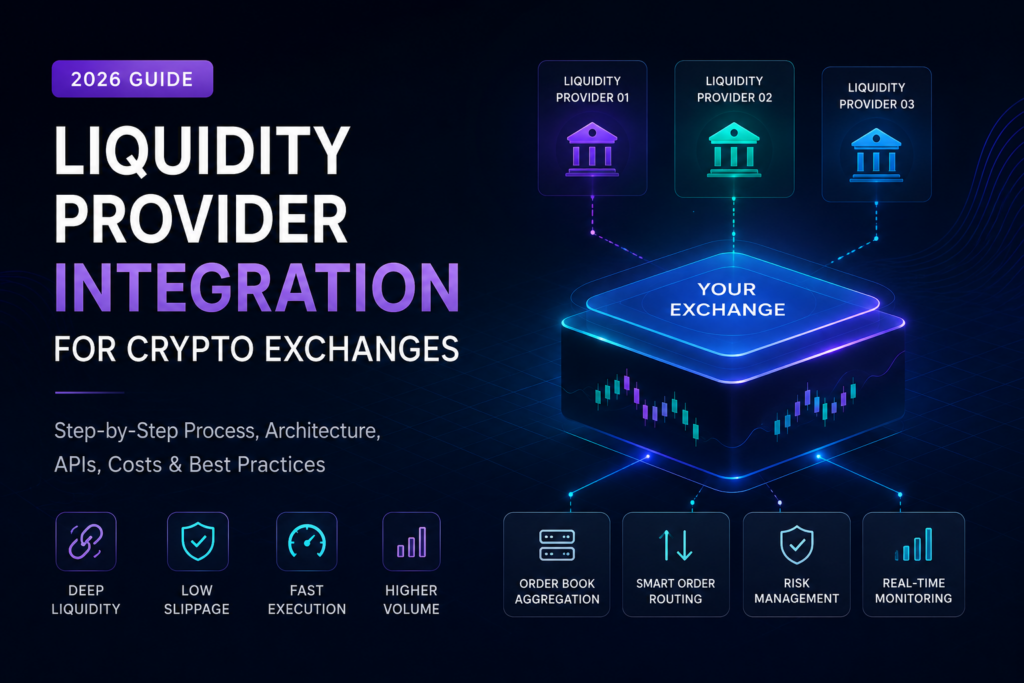
Most successful exchanges today use multiple liquidity providers combined through liquidity aggregation and smart order routing systems to ensure the best execution quality.
What Is a Liquidity Provider?
A liquidity provider (LP) is an institution, exchange, market maker, broker, or trading firm that supplies buy and sell orders to financial markets.
In a crypto exchange environment, liquidity providers continuously offer:
-
Buy orders (bids)
-
Sell orders (asks)
-
Market depth
-
Pricing data
These orders populate your exchange order book and enable traders to buy or sell assets without waiting for another user to take the opposite side of the trade.
Without liquidity providers, a newly launched exchange often faces:
-
Empty order books
-
Poor pricing
-
Large spreads
-
Slow execution
-
Reduced user trust
Liquidity providers effectively solve these issues by ensuring there is sufficient trading activity available at all times.
What Problems Does Liquidity Provider Integration Solve?
Many startup exchanges focus heavily on UI design, matching engines, and trading features while underestimating the importance of liquidity.
However, liquidity is often the single biggest factor determining whether traders stay or leave.
Empty Order Books
New exchanges rarely have enough users to create healthy organic trading activity.
Without liquidity integration:
-
Traders see little market depth
-
Large orders impact prices significantly
-
Markets appear inactive
Liquidity providers solve this by supplying immediate market depth.
High Slippage
Slippage occurs when orders execute at different prices than expected.
For example:
A trader expects to buy Bitcoin at $100,000 but receives execution at $100,250 because insufficient liquidity exists at the requested price level.
Proper liquidity integration dramatically reduces slippage by providing deeper order books.
Wide Bid-Ask Spreads
The spread is the difference between:
-
Highest buy price
-
Lowest sell price
Wide spreads discourage trading and create a poor user experience.
Liquidity providers help maintain tighter spreads that attract traders.
Low Trading Volume
Many users evaluate exchanges based on trading activity.
Low liquidity often leads to:
-
Lower volume
-
Reduced trust
-
Fewer returning traders
Liquidity integration helps create a more active market environment.
Poor User Retention
Traders rarely return to platforms where:
-
Orders execute slowly
-
Prices fluctuate excessively
-
Market depth is limited
Deep liquidity directly improves customer retention and platform reputation.
Why Liquidity Integration Is Critical
Better User Experience
Fast execution is one of the most important metrics for trader satisfaction.
Users expect trades to execute instantly regardless of market conditions.
Increased Revenue
More trading activity means:
-
More transaction fees
-
Higher volume
-
Better monetization
Liquidity integration directly impacts exchange profitability.
Competitive Advantage
In highly competitive crypto markets, traders compare:
-
Liquidity
-
Execution quality
-
Trading costs
-
Market depth
Exchanges with stronger liquidity consistently outperform competitors.
Institutional Readiness
Professional traders require:
-
Large order execution
-
Stable pricing
-
Deep liquidity pools
Without institutional-grade liquidity, attracting larger traders becomes difficult.
How Crypto Exchange Liquidity Works
Every crypto exchange relies on an order book.
The order book contains:
Buy Orders (Bids)
Orders placed by traders willing to buy assets.
Sell Orders (Asks)
Orders placed by traders willing to sell assets.
Market Depth
The quantity of buy and sell orders available across different price levels.
Matching Engine
The matching engine pairs compatible buy and sell orders.
When a trader places an order:
-
Order enters matching engine
-
Engine searches available liquidity
-
Best execution price is selected
-
Trade is completed
Liquidity providers continuously feed additional orders into this process, ensuring sufficient market depth.
Without external liquidity sources, exchanges must rely entirely on organic user activity, which is usually insufficient during early growth stages.
Types of Liquidity Providers
Not all liquidity providers operate in the same way. Understanding the different types of liquidity sources can help exchange operators choose the right integration strategy based on their target market, trading volume, and scalability goals.
Most successful crypto exchanges use a combination of multiple liquidity sources rather than relying on a single provider.
Centralized Exchange Liquidity
One of the most common approaches is sourcing liquidity from established cryptocurrency exchanges.
Large exchanges maintain deep order books with substantial trading activity, making them attractive liquidity sources for new platforms.
Benefits include:
-
Immediate market depth
-
Large trading volumes
-
Competitive pricing
-
Proven infrastructure
Examples include major global exchanges that provide API-based access to market data and execution services.
By connecting to these exchanges through liquidity provider APIs, smaller exchanges can offer competitive trading conditions without needing to build liquidity organically from day one.
Market Makers
Market makers are professional trading firms that continuously place buy and sell orders into markets.
Their primary goal is to profit from the spread between bid and ask prices while providing liquidity to exchanges.
Market makers help:
-
Reduce spreads
-
Improve market depth
-
Increase trading activity
-
Stabilize pricing
Many high-volume crypto exchanges partner with multiple market makers to ensure healthy order books across all trading pairs.
Market makers are especially valuable for newly listed tokens that may not yet have significant organic trading activity.
Liquidity Aggregators
A liquidity aggregator combines pricing and order book data from multiple liquidity providers into a single unified system.
Instead of relying on one provider, the aggregator continuously analyzes available liquidity and routes orders to the best source.
Benefits include:
-
Better pricing
-
Improved execution quality
-
Reduced slippage
-
Increased reliability
-
Provider redundancy
Liquidity aggregation has become the preferred approach for modern crypto exchanges because it minimizes dependency on any single provider.
Prime Broker Liquidity Providers
Institutional exchanges often work with prime brokers that aggregate liquidity from multiple venues while providing additional services such as:
-
Credit facilities
-
Risk management
-
Trade settlement
-
Institutional execution
Prime broker integrations are typically used by larger exchanges serving professional traders and institutions.
Decentralized Liquidity Sources
Some exchanges also connect to decentralized liquidity pools.
These pools provide access to liquidity from decentralized finance (DeFi) ecosystems and can be used to support token swaps and decentralized trading functionality.
Benefits include:
-
Access to DeFi liquidity
-
Expanded asset coverage
-
Reduced dependence on centralized venues
However, decentralized liquidity introduces additional considerations related to smart contracts, gas fees, and blockchain latency.
Single Liquidity Provider vs Multiple Liquidity Providers
One of the most important architectural decisions when building a crypto exchange is whether to integrate a single liquidity provider or aggregate multiple providers.
While a single provider may be easier to implement initially, multi-provider architectures generally deliver better performance and long-term scalability.
| Feature | Single Provider | Multiple Providers |
|---|---|---|
| Initial Setup Cost | Lower | Higher |
| Implementation Complexity | Low | Medium |
| Market Depth | Limited | High |
| Reliability | Medium | High |
| Redundancy | Weak | Strong |
| Slippage | Higher | Lower |
| Spread Quality | Average | Better |
| Scalability | Limited | Excellent |
Advantages of a Single Provider
A single liquidity provider can be appropriate for:
-
Early-stage exchanges
-
MVP launches
-
Budget-conscious startups
Advantages include:
-
Faster implementation
-
Lower development costs
-
Simpler infrastructure
-
Easier monitoring
However, relying on one provider creates a single point of failure.
If that provider experiences downtime, pricing issues, or API disruptions, your exchange operations may be impacted immediately.
Advantages of Multiple Providers
Most mature exchanges use multiple liquidity providers.
Benefits include:
-
Better pricing opportunities
-
Higher market depth
-
Improved redundancy
-
Reduced operational risk
-
Superior execution quality
When one provider becomes unavailable, traffic can automatically be routed to alternative sources.
This approach significantly improves platform reliability and user experience.
Which Approach Is Best?
For startups launching quickly, a single provider may be acceptable during the early stages.
However, exchanges targeting long-term growth should plan for a multi-provider liquidity architecture from the beginning.
A scalable exchange should be designed to support:
-
Additional liquidity providers
-
Smart order routing
-
Liquidity aggregation
-
Automated failover systems
This creates a foundation capable of supporting significant trading volume growth over time.
Top Liquidity Providers in 2026
Choosing the right liquidity provider is one of the most important decisions when launching a crypto exchange. The quality of your liquidity directly impacts trading volume, user satisfaction, spreads, slippage, and overall platform credibility.
While there are hundreds of liquidity sources available today, most successful exchanges rely on a combination of major exchanges, institutional market makers, and liquidity aggregators to create a deep and reliable trading environment.
The best liquidity provider for your exchange depends on factors such as:
-
Target market
-
Supported trading pairs
-
Trading volume expectations
-
Geographic restrictions
-
Regulatory requirements
-
Budget and technical architecture
Below are some of the most widely used liquidity sources in 2026.
Binance Liquidity
Binance remains one of the largest cryptocurrency exchanges in the world by trading volume.
Many exchanges use Binance as a liquidity source because of its:
-
Deep order books
-
Large trading volumes
-
Broad asset coverage
-
Competitive spreads
-
High API reliability
Benefits:
-
Excellent liquidity for major pairs
-
Large number of supported assets
-
Mature infrastructure
Considerations:
-
Dependence on a single venue
-
Regional regulatory restrictions may apply
For startup exchanges, Binance-based liquidity often provides a strong foundation during the initial growth phase.
For technical reference, developers can review the official Binance Spot API documentation.
Binance’s developer documentation covers official Spot API endpoints and related API information.
OKX Liquidity
OKX continues to be a major liquidity source for both spot and derivatives markets.
Strengths include:
-
High derivatives volume
-
Strong institutional participation
-
Deep market depth
-
Advanced trading infrastructure
Benefits:
-
Excellent futures liquidity
-
Strong global presence
-
Reliable API ecosystem
Many exchanges integrate OKX alongside Binance to diversify liquidity sources and improve redundancy.
Bybit Liquidity
Bybit has become a leading venue for derivatives and perpetual futures trading.
Advantages include:
-
High futures liquidity
-
Active trader community
-
Competitive spreads
-
Strong matching engine performance
Bybit is particularly attractive for exchanges targeting:
-
Professional traders
-
Futures markets
-
Margin trading products
Kraken Liquidity
Kraken is known for regulatory compliance and institutional-grade infrastructure.
Benefits include:
-
Strong reputation
-
High-quality liquidity
-
Institutional participation
-
Security-focused operations
Exchanges serving regulated markets often consider Kraken-based liquidity due to its reputation and stability.
Coinbase Institutional Liquidity
Coinbase offers institutional trading services and liquidity solutions suitable for larger organizations.
Advantages:
-
Institutional-grade infrastructure
-
Regulatory credibility
-
Deep liquidity for major assets
-
Enterprise-level support
This option is often considered by exchanges targeting institutional traders and enterprise clients.
Coinbase also provides official Coinbase Exchange API documentation for trading and market data APIs.
Coinbase says its Exchange APIs include trading APIs for orders/account access and market data APIs for public market data.
Professional Market Makers
Many successful exchanges work directly with professional market-making firms instead of relying exclusively on exchange-based liquidity.
Market makers continuously provide:
-
Buy orders
-
Sell orders
-
Market depth
-
Spread management
Benefits:
-
Better liquidity consistency
-
Reduced spreads
-
Increased trading activity
-
Improved market quality
Professional market makers are especially valuable for:
-
Newly launched exchanges
-
New token listings
-
Low-volume trading pairs
Liquidity Aggregators
Rather than choosing a single liquidity provider, many exchanges use liquidity aggregators.
A liquidity aggregator combines multiple liquidity sources into one unified system.
Benefits include:
-
Better execution quality
-
Reduced slippage
-
Improved reliability
-
Best-price routing
-
Higher market depth
Instead of routing every trade to one provider, the system automatically selects the best available liquidity source in real time.
For most modern crypto exchanges, liquidity aggregation represents the preferred long-term strategy.
How to Choose the Right Liquidity Provider
Before selecting a liquidity provider, evaluate the following factors:
Market Depth
The provider should offer sufficient liquidity for your target trading pairs.
API Reliability
Stable APIs are essential for maintaining exchange uptime and execution quality.
Latency
Low-latency connections help reduce execution delays and improve trading performance.
Asset Coverage
Ensure the provider supports the assets and markets your exchange plans to offer.
Regulatory Considerations
Verify that the liquidity source aligns with the regulatory requirements of your target jurisdictions.
Scalability
Your liquidity infrastructure should be capable of supporting future growth without requiring major architectural changes.
Recommended Approach for New Exchanges
For most startups, the best approach is:
-
Launch with one or two reputable liquidity providers.
-
Implement a scalable liquidity engine.
-
Add additional providers as volume grows.
-
Introduce liquidity aggregation and smart order routing.
-
Continuously monitor execution quality and market depth.
This strategy balances implementation costs with long-term scalability while delivering a professional trading experience from day one.
Ultimately, the most successful exchanges are not those with the largest number of liquidity providers, but those that integrate liquidity intelligently, manage execution efficiently, and provide traders with a consistently reliable market environment.
Liquidity Aggregator Architecture: How Modern Exchanges Combine Multiple Liquidity Sources
As cryptocurrency markets become increasingly competitive, relying on a single liquidity provider is no longer sufficient for most exchanges. Modern trading platforms use liquidity aggregators to combine liquidity from multiple sources and deliver better execution quality, deeper order books, and greater reliability.
Liquidity aggregation has become a standard component of enterprise-grade crypto exchange architecture because it helps exchanges offer a professional trading experience while reducing dependency on any single provider.
For exchanges planning long-term growth, understanding liquidity aggregator architecture is essential.
What Is a Liquidity Aggregator?
A liquidity aggregator is a system that collects market data and liquidity from multiple providers and combines them into a unified trading environment.
Instead of sourcing orders from only one exchange or market maker, the aggregator continuously analyzes multiple liquidity sources and determines the best available execution path.
A liquidity aggregator can connect to:
-
Cryptocurrency exchanges
-
Market makers
-
Prime brokers
-
OTC liquidity providers
-
Institutional trading venues
-
Decentralized liquidity pools
The system then combines this information into a single order book visible to traders.
From the user’s perspective, the process is seamless.
Behind the scenes, however, sophisticated algorithms are constantly monitoring liquidity conditions and routing orders to the optimal source.
Why Exchanges Use Liquidity Aggregation
Liquidity aggregation solves several major challenges that exchanges face when relying on a single liquidity source.
Improved Market Depth
Different liquidity providers often have different order books.
By combining multiple sources, exchanges gain access to significantly more liquidity than any individual provider can offer.
Benefits include:
-
Larger order capacity
-
Reduced slippage
-
Better execution quality
-
Increased trader confidence
This is especially important for high-volume traders and institutional clients.
Better Pricing
Prices vary across different exchanges and liquidity providers.
A liquidity aggregator continuously compares available prices and identifies the best execution opportunity.
This helps traders receive:
-
Better fills
-
Tighter spreads
-
More competitive pricing
Improved pricing directly contributes to higher trader satisfaction and increased trading volume.
Reduced Risk
Relying on a single liquidity provider creates a single point of failure.
If that provider experiences:
-
Downtime
-
API failures
-
Connectivity issues
-
Market disruptions
your exchange operations may be negatively affected.
A multi-provider liquidity architecture significantly reduces operational risk by introducing redundancy.
Increased Scalability
As exchanges grow, liquidity requirements increase.
Liquidity aggregation provides a scalable foundation capable of supporting:
-
Additional trading pairs
-
Higher volumes
-
Institutional trading activity
-
Global expansion
Core Components of Liquidity Aggregator Architecture
A professional liquidity aggregation system consists of several specialized components working together.
Provider Connectors
Provider connectors establish secure communication with liquidity sources.
These connectors typically support:
-
REST APIs
-
WebSocket APIs
-
FIX Protocol connections
Each connector is responsible for:
-
Authentication
-
Market data retrieval
-
Order execution
-
Connection monitoring
Because every provider uses different APIs, connectors normalize incoming data into a common format.
Market Data Engine
The market data engine processes real-time information received from liquidity providers.
This includes:
-
Bid prices
-
Ask prices
-
Order book depth
-
Trade activity
-
Market updates
The engine continuously updates market information and distributes it throughout the exchange infrastructure.
Low latency is critical at this stage because even small delays can negatively impact execution quality.
Liquidity Engine
The liquidity engine acts as the central brain of the aggregation system.
Its responsibilities include:
-
Combining order books
-
Ranking liquidity sources
-
Evaluating market conditions
-
Selecting execution paths
The liquidity engine determines which provider offers the best liquidity at any given moment.
Order Book Engine
The order book engine merges liquidity from multiple providers into a single consolidated order book.
Instead of displaying separate liquidity pools, traders see one unified market.
Benefits include:
-
Better market transparency
-
Increased depth
-
Simplified trading experience
This is often referred to as a consolidated order book.
Smart Order Routing Engine
Smart Order Routing (SOR) is one of the most important components of liquidity aggregation.
The routing engine analyzes:
-
Available liquidity
-
Market depth
-
Execution costs
-
Provider latency
-
Slippage risk
Based on these factors, it determines the optimal execution route.
For example:
A trader places a large Bitcoin order.
Instead of executing the entire order through a single provider, the routing engine may split the order across multiple liquidity sources to achieve the best average price.
This process helps reduce slippage and improve execution quality.
Example Liquidity Aggregation Workflow
Consider an exchange connected to:
-
Binance
-
OKX
-
Bybit
-
Institutional Market Maker
When a user places an order:
Step 1: Market Data Collection
The aggregator receives real-time order book data from all providers.
Step 2: Order Book Consolidation
The liquidity engine combines the available liquidity into a unified market view.
Step 3: Best Price Analysis
The routing engine identifies the most favorable execution path.
Step 4: Order Execution
The trade is executed through one or more liquidity providers.
Step 5: Execution Reporting
Results are returned to the trader and recorded by the exchange.
This entire process typically occurs within milliseconds.
Smart Order Routing Best Practices
To maximize performance, exchanges should implement:
Low-Latency Infrastructure
Fast connectivity improves execution quality and reduces slippage.
Provider Ranking Systems
Evaluate providers based on:
-
Reliability
-
Spread quality
-
Execution speed
-
Fill rates
Failover Routing
Automatically redirect orders when a provider becomes unavailable.
Continuous Monitoring
Track:
-
Liquidity health
-
Execution quality
-
Latency
-
API performance
This helps identify problems before they affect traders.
Exchanges should continuously monitor market depth, liquidity quality, trading volume, and pricing consistency across connected providers. For additional market intelligence, exchange rankings, and liquidity metrics, many operators use CoinMarketCap‘s data services and API infrastructure.
Building a Scalable Liquidity Aggregation System
The most successful exchanges build liquidity aggregation as a core part of their architecture rather than adding it later.
A scalable crypto exchange should support:
-
Multiple liquidity providers
-
Smart order routing
-
Order book consolidation
-
Provider failover
-
Real-time monitoring
-
Institutional-grade execution
This approach creates a resilient infrastructure capable of supporting future growth while delivering the high-quality trading experience modern users expect.
For startups and enterprises alike, liquidity aggregation is no longer a competitive advantage—it has become a fundamental requirement for operating a successful crypto exchange in 2026 and beyond.
Step-by-Step Liquidity Provider Integration Process (2026 Implementation Guide)
Successful liquidity provider integration requires much more than simply connecting an API. Modern crypto exchanges must build a scalable infrastructure capable of handling real-time market data, order execution, risk management, monitoring, and future growth.
A well-designed liquidity provider integration enables exchanges to deliver deep liquidity, fast execution, and a professional trading experience while minimizing operational risks.
The following implementation process represents a proven framework used by professional crypto exchange development teams.
Step 1: Define Your Exchange Business Model
Before selecting a liquidity provider, you must define the type of exchange you are building.
Different exchange models have different liquidity requirements.
Common models include:
Spot Trading Exchange
Users buy and sell cryptocurrencies at current market prices.
Examples:
-
BTC/USDT
-
ETH/USDT
-
SOL/USDT
Margin Trading Platform
Users trade with borrowed funds and leverage.
Additional liquidity and risk management considerations are required.
Futures & Derivatives Exchange
Supports perpetual contracts, futures contracts, and leveraged trading products.
Requires significantly deeper liquidity and advanced execution infrastructure.
Multi-Asset Trading Platform
Supports:
-
Crypto
-
Forex
-
Commodities
-
Stocks
-
CFDs
Each asset class may require different liquidity providers.
Defining the exchange model early helps determine the appropriate liquidity architecture and integration strategy.
Step 2: Select Liquidity Providers
The next step is choosing appropriate liquidity sources.
Selection criteria should include:
Market Depth
Evaluate order book depth across supported trading pairs.
API Reliability
Provider APIs must demonstrate consistent uptime and stability.
Asset Coverage
Ensure supported assets align with your exchange roadmap.
Execution Quality
Review:
-
Slippage
-
Fill rates
-
Latency
-
Spread quality
Regulatory Compatibility
Verify that providers can legally support your target jurisdictions.
Many exchanges begin with one or two providers and later expand into a multi-provider liquidity architecture.
Step 3: Establish Secure API Connectivity
Most liquidity provider integration projects begin by connecting to provider APIs.
Modern liquidity providers typically offer:
REST APIs
Used for:
-
Authentication
-
Account management
-
Configuration
-
Historical data
WebSocket APIs
Used for:
-
Real-time order books
-
Market updates
-
Trade feeds
-
Execution updates
FIX Protocol
Often used by institutional-grade exchanges requiring ultra-low latency execution.
A secure integration should include:
-
API key encryption
-
IP whitelisting
-
Secure credential storage
-
Access controls
-
Audit logging
Security should never be treated as an afterthought during liquidity provider implementation.
Step 4: Build a Market Data Layer
After connectivity is established, the exchange must process incoming market data.
Liquidity providers generally deliver:
-
Bid prices
-
Ask prices
-
Market depth
-
Trade activity
-
Volume metrics
The market data layer is responsible for:
Data Collection
Receiving information from providers.
Data Validation
Identifying malformed or invalid data.
Data Processing
Preparing data for internal exchange systems.
Data Distribution
Delivering updates to:
-
Trading interfaces
-
Matching engines
-
Risk systems
-
Analytics services
This layer must be optimized for low latency and high availability.
Step 5: Normalize Liquidity Provider Data
One of the most overlooked challenges in crypto exchange integration is data normalization.
Different liquidity providers use different formats.
For example:
Provider A:
BTCUSDT
Provider B:
BTC-USDT
Provider C:
BTC_USDT
Without normalization, integrating multiple providers becomes extremely difficult.
A normalization layer should standardize:
-
Trading symbols
-
Order types
-
Market data structures
-
Precision rules
-
Volume formats
This allows downstream systems to operate consistently regardless of provider differences.
Step 6: Implement a Liquidity Engine
The liquidity engine acts as the core of the liquidity provider integration architecture.
Responsibilities include:
-
Order book consolidation
-
Provider management
-
Market data aggregation
-
Liquidity monitoring
-
Routing preparation
The liquidity engine continuously evaluates:
-
Available liquidity
-
Provider performance
-
Market conditions
-
Execution opportunities
A scalable liquidity engine allows new providers to be added without major architectural changes.
Step 7: Build Smart Order Routing
Smart Order Routing (SOR) is essential for maximizing execution quality.
The routing engine determines where orders should be executed based on:
Best Available Price
Identify the most favorable execution venue.
Market Depth
Ensure sufficient liquidity exists.
Execution Cost
Reduce trading costs where possible.
Provider Latency
Prioritize fast execution paths.
Reliability Metrics
Avoid unstable providers.
For large orders, smart routing may split execution across multiple liquidity providers to minimize slippage and improve fill quality.
This approach is commonly used by enterprise-grade crypto exchanges.
Step 8: Integrate Risk Management Controls
Liquidity integration should always be accompanied by robust risk management systems.
Key controls include:
Exposure Limits
Prevent excessive dependency on individual providers.
Position Monitoring
Track market exposure in real time.
Slippage Protection
Prevent executions outside acceptable thresholds.
Circuit Breakers
Pause trading during abnormal market conditions.
Provider Health Monitoring
Detect outages and execution issues automatically.
Risk management is especially important for exchanges offering margin trading or derivatives products.
Step 9: Implement Failover & Redundancy
Provider outages are inevitable.
A resilient exchange architecture should include automatic failover mechanisms.
Examples include:
Provider Failover
Switch to alternative liquidity providers during outages.
Backup Market Data Feeds
Maintain pricing continuity.
Redundant Infrastructure
Avoid single points of failure.
Automated Recovery
Restore services quickly after disruptions.
Redundancy is one of the defining characteristics of enterprise-grade crypto exchange architecture.
Step 10: Conduct Performance Testing
Before production deployment, extensive testing is required.
Areas to test include:
Latency Testing
Measure end-to-end execution performance.
Load Testing
Simulate high trading volumes.
Order Routing Testing
Validate routing decisions.
Failover Testing
Verify redundancy mechanisms.
Security Testing
Assess API and infrastructure security.
Testing helps identify bottlenecks before they impact real users.
Step 11: Deploy Monitoring & Observability
Liquidity provider integration should never operate without monitoring.
Key metrics include:
Provider Availability
Track uptime and connectivity.
API Performance
Monitor response times.
Market Data Health
Verify order book integrity.
Execution Quality
Measure slippage and fill rates.
Trading Volume
Analyze liquidity utilization.
Real-time observability enables teams to identify issues quickly and maintain high platform reliability.
Step 12: Scale the Liquidity Infrastructure
As trading volume grows, exchanges should continuously improve liquidity infrastructure.
Common growth strategies include:
-
Adding new liquidity providers
-
Introducing liquidity aggregation
-
Expanding asset coverage
-
Optimizing smart order routing
-
Enhancing monitoring systems
A flexible architecture allows exchanges to scale without requiring complete infrastructure redesigns.
Key Takeaway
Liquidity provider integration is not simply an API connection—it is a critical component of crypto exchange architecture.
A successful implementation requires:
-
Secure API connectivity
-
Market data processing
-
Data normalization
-
Smart order routing
-
Risk management
-
Monitoring and observability
-
Multi-provider scalability
Exchanges that invest in robust liquidity infrastructure gain a significant competitive advantage through better execution quality, deeper markets, increased trader satisfaction, and long-term operational resilience.
Cost of Liquidity Provider Integration (2026 Pricing Breakdown)
One of the most common questions founders ask when launching a crypto exchange is:
“How much does liquidity provider integration cost?”
The answer depends on several factors, including exchange complexity, the number of liquidity providers, supported trading products, infrastructure requirements, and compliance considerations.
A basic integration may cost a few thousand dollars, while enterprise-grade liquidity aggregation systems can require six-figure investments.
Understanding the cost structure helps exchange operators plan realistic budgets and avoid unexpected expenses during development.
Factors That Affect Liquidity Provider Integration Cost
The total cost of liquidity provider integration depends on multiple technical and business factors.
Number of Liquidity Providers
A single liquidity provider integration is significantly cheaper than a multi-provider liquidity aggregation system.
Single Provider:
-
Lower implementation complexity
-
Faster deployment
-
Reduced maintenance
Multi-Provider Architecture:
-
More API integrations
-
Smart order routing requirements
-
Liquidity aggregation engine
-
Failover mechanisms
As the number of providers increases, development effort grows accordingly.
Exchange Type
Different exchange models require different levels of integration complexity.
Spot Exchange
The most affordable option.
Requirements:
-
Market data feeds
-
Order execution
-
Basic liquidity routing
Margin Trading Platform
Additional requirements include:
-
Borrowing mechanisms
-
Risk management systems
-
Margin calculations
-
Liquidation logic
Futures & Derivatives Exchange
Typically the most expensive category.
Additional complexity includes:
-
Leverage management
-
Position tracking
-
Funding rate calculations
-
Advanced liquidation systems
-
Real-time risk monitoring
Liquidity Aggregation Requirements
If the exchange uses multiple liquidity providers, a liquidity aggregator must be developed.
Features may include:
-
Consolidated order books
-
Smart order routing
-
Best-price selection
-
Provider ranking
-
Execution optimization
Liquidity aggregation significantly increases implementation costs but delivers superior execution quality.
Infrastructure Requirements
Infrastructure costs depend on:
-
Expected trading volume
-
Market update frequency
-
Geographic distribution
-
Latency requirements
Professional exchanges often require:
-
Dedicated servers
-
Load balancing
-
Database replication
-
Monitoring systems
-
Backup environments
Low-latency trading infrastructure increases overall project costs but improves platform performance.
Security Requirements
Security should never be compromised to reduce costs.
Professional liquidity provider integrations typically include:
-
API key encryption
-
Secure credential storage
-
Access controls
-
Audit logging
-
DDoS protection
-
Vulnerability assessments
Security investments help protect both users and exchange operations.
Liquidity Provider Integration Cost Breakdown
The following ranges represent typical market pricing in 2026.
Basic Liquidity Provider Integration
Estimated Cost:
$15,000 – $30,000
Suitable for:
-
Startup exchanges
-
MVP platforms
-
Early-stage projects
Typically includes:
-
Single liquidity provider
-
REST API integration
-
WebSocket market data
-
Basic order execution
-
Simple monitoring
Advantages:
-
Faster deployment
-
Lower budget requirements
-
Reduced complexity
Limitations:
-
Single point of failure
-
Limited scalability
-
Reduced liquidity diversity
Mid-Level Exchange Integration
Estimated Cost:
$30,000 – $80,000
Suitable for:
-
Growth-stage exchanges
-
Regional trading platforms
-
Multi-market exchanges
Typically includes:
-
Multiple liquidity providers
-
Liquidity aggregation
-
Smart order routing
-
Risk controls
-
Enhanced monitoring
Advantages:
-
Improved execution quality
-
Better market depth
-
Increased redundancy
This is often the preferred starting point for serious crypto exchange businesses.
Enterprise-Grade Liquidity Infrastructure
Estimated Cost:
$100,000 – $300,000+
Suitable for:
-
Institutional exchanges
-
High-volume trading platforms
-
Global exchange operators
Typically includes:
-
Multi-provider liquidity aggregation
-
Institutional-grade APIs
-
Advanced routing systems
-
Custom risk engines
-
High-availability infrastructure
-
Regulatory compliance features
-
Advanced observability
Benefits include:
-
Superior execution quality
-
Institutional readiness
-
Global scalability
-
High resilience
Most large exchanges eventually evolve toward this architecture.
Ongoing Operational Costs
Development cost is only one part of the equation.
Exchanges should also budget for ongoing operational expenses.
Infrastructure
Monthly expenses may include:
-
Cloud hosting
-
Databases
-
Monitoring systems
-
Backup environments
Typical range:
$500 – $10,000+ per month
depending on platform scale.
Liquidity Provider Fees
Some providers charge:
-
Monthly access fees
-
Volume-based fees
-
Revenue-sharing arrangements
Pricing varies significantly between providers.
Security & Maintenance
Regular maintenance may include:
-
API updates
-
Security patches
-
Performance optimization
-
Monitoring improvements
Ignoring maintenance often leads to technical debt and operational risks.
Hidden Costs Many Founders Overlook
Many crypto exchange projects underestimate implementation costs because they focus only on API connectivity.
However, professional liquidity provider integration also requires:
Data Normalization
Each provider uses different formats.
Significant engineering effort is required to standardize data across systems.
Smart Order Routing
Routing engines require:
-
Performance testing
-
Algorithm development
-
Monitoring
Failover Systems
Redundancy mechanisms add complexity but are critical for uptime.
Compliance Requirements
Depending on jurisdiction, exchanges may require:
-
KYC integration
-
AML monitoring
-
Audit systems
-
Regulatory reporting
These requirements can substantially impact project budgets.
Build vs Buy: Which Is More Cost Effective?
Custom Development
Advantages:
-
Full control
-
Unlimited customization
-
Better scalability
-
Competitive differentiation
Best suited for:
-
Long-term exchange businesses
-
Institutional platforms
-
High-growth startups
White Label Solutions
Advantages:
-
Faster launch
-
Lower initial investment
-
Reduced development time
Best suited for:
-
Market validation
-
Early-stage projects
-
Faster time-to-market
Many successful exchanges begin with white-label infrastructure before transitioning to custom-built systems as volume grows.
How to Reduce Liquidity Provider Integration Costs
To optimize budget without sacrificing quality:
Start with One or Two Providers
Avoid unnecessary complexity during the initial launch.
Build Scalable Architecture
Design infrastructure that supports future expansion.
Prioritize Core Features
Focus on:
-
Liquidity
-
Security
-
Execution quality
before implementing secondary features.
Use Proven Technology
Avoid experimental systems for mission-critical trading infrastructure.
Work with Experienced Development Teams
Experienced crypto exchange developers can significantly reduce implementation risks and long-term costs.
Key Takeaway
Liquidity provider integration cost depends on the complexity of the exchange, the number of liquidity sources, and the level of execution quality required.
Typical investment ranges in 2026 are:
-
Basic Integration: $15,000 – $30,000
-
Mid-Level Exchange: $30,000 – $80,000
-
Enterprise Infrastructure: $100,000 – $300,000+
While cost is important, exchanges should focus on building reliable, scalable liquidity infrastructure rather than simply choosing the cheapest implementation option.
A well-designed liquidity system improves trader satisfaction, increases trading volume, strengthens platform credibility, and creates a foundation for long-term growth.
Security & Compliance Considerations for Liquidity Provider Integration
Security and compliance are among the most critical aspects of liquidity provider integration. While deep liquidity and fast execution improve the trading experience, a poorly secured integration can expose an exchange to financial losses, operational disruptions, regulatory penalties, and reputational damage.
Modern crypto exchanges must treat liquidity provider integration as a security-sensitive component of their overall trading infrastructure.
Building a secure exchange requires more than liquidity integration. Modern trading platforms also depend on secure wallet infrastructure, smart contract development, blockchain security, and scalable backend systems. Explore our Blockchain Development Services to learn how we help businesses build enterprise-grade Web3 and trading platforms.
Whether you’re connecting to a single liquidity provider or operating a sophisticated liquidity aggregation system, security and compliance should be built into the architecture from day one.
Why Security Matters in Liquidity Provider Integration
Liquidity providers often have direct influence over:
-
Market data
-
Trade execution
-
Order routing
-
Pricing feeds
-
Trading operations
A security failure can impact:
-
Customer funds
-
Market integrity
-
Exchange reputation
-
Regulatory compliance
Common risks include:
-
API credential theft
-
Unauthorized trade execution
-
Market manipulation
-
Service disruption
-
Data breaches
As crypto markets continue to mature, traders increasingly choose exchanges based on security standards and operational reliability.
Securing Liquidity Provider APIs
Most liquidity providers connect through APIs, making API security one of the highest-priority areas of the integration process.
API Key Protection
API credentials should never be:
-
Stored in source code
-
Exposed in logs
-
Shared through unsecured channels
Best practices include:
-
Encrypting API credentials at rest
-
Using secure secret management systems
-
Implementing key rotation policies
-
Restricting credential access
Many exchanges use dedicated secret management platforms to secure sensitive credentials.
IP Whitelisting
Most professional liquidity providers support IP whitelisting.
This allows API access only from approved servers.
Benefits include:
-
Reduced attack surface
-
Protection against credential misuse
-
Improved operational security
Whenever possible, production systems should be restricted to approved IP addresses.
Least Privilege Access
API credentials should have only the permissions required for their specific functions.
For example:
Market data APIs may require:
-
Read access only
Execution APIs may require:
-
Trading permissions
Administrative permissions should never be granted unnecessarily.
Exchange Risk Management Controls
Strong exchange risk management helps prevent trading-related incidents and operational failures.
Exposure Limits
Exchanges should define maximum exposure thresholds for:
-
Individual trading pairs
-
Liquidity providers
-
Asset classes
-
Trading accounts
These controls help prevent excessive concentration risk.
Slippage Protection
Unexpected market conditions can cause significant execution losses.
Slippage controls should:
-
Define acceptable thresholds
-
Reject abnormal executions
-
Alert operators when limits are exceeded
Position Monitoring
Real-time monitoring helps exchanges track:
-
Open positions
-
Market exposure
-
Liquidity utilization
-
Provider dependency
Continuous visibility is essential for maintaining operational stability.
Circuit Breakers
Circuit breakers temporarily pause trading during abnormal market conditions.
Examples include:
-
Flash crashes
-
Extreme volatility
-
Market manipulation attempts
-
Provider outages
These mechanisms help protect both traders and exchange infrastructure.
Protecting Market Data Infrastructure
Market data is the foundation of every trading platform.
Compromised or inaccurate data can lead to:
-
Incorrect pricing
-
Poor execution
-
Financial losses
-
User complaints
Data Validation
Incoming market data should be validated before being distributed throughout the platform.
Validation checks may include:
-
Price sanity checks
-
Volume validation
-
Symbol verification
-
Timestamp verification
Multiple Data Sources
Using multiple liquidity providers improves security by reducing dependence on a single source.
Benefits include:
-
Better pricing validation
-
Increased redundancy
-
Improved reliability
Real-Time Monitoring
Exchanges should continuously monitor:
-
Data latency
-
Feed integrity
-
Missing updates
-
Abnormal market behavior
Early detection helps prevent larger operational issues.
DDoS Protection and Infrastructure Security
Crypto exchanges are frequent targets of distributed denial-of-service (DDoS) attacks.
A successful attack can disrupt:
-
Trading operations
-
Market data feeds
-
Liquidity provider connectivity
-
User access
Recommended Protections
Implement:
-
Web application firewalls (WAF)
-
DDoS mitigation services
-
Rate limiting
-
Traffic filtering
-
Redundant infrastructure
Professional exchanges typically deploy multiple layers of protection to maintain uptime during attack scenarios.
Logging, Monitoring & Audit Trails
Observability is essential for enterprise-grade crypto exchange security.
Every critical action should be logged.
Examples include:
-
API authentication events
-
Trade execution requests
-
Liquidity provider status changes
-
Administrative actions
-
Configuration updates
Benefits of Audit Logging
Audit trails help:
-
Investigate incidents
-
Support compliance requirements
-
Detect suspicious activity
-
Improve operational visibility
Logs should be securely stored and protected against tampering.
KYC & AML Compliance for Crypto Exchanges
Liquidity integration is only one part of operating a compliant exchange.
Most jurisdictions require crypto exchanges to implement:
Know Your Customer (KYC)
KYC procedures verify customer identities.
Typical verification requirements include:
-
Government-issued identification
-
Proof of address
-
Biometric verification
-
Sanctions screening
KYC helps reduce fraud and improve regulatory compliance.
Anti-Money Laundering (AML)
AML programs help identify suspicious financial activity.
Common AML controls include:
-
Transaction monitoring
-
Risk scoring
-
Suspicious activity reporting
-
Enhanced due diligence
AML compliance has become a core requirement for exchanges operating in regulated markets.
Sanctions Screening
Exchanges should screen users against:
-
International sanctions lists
-
Politically exposed persons (PEP) databases
-
High-risk jurisdictions
These checks help reduce regulatory risk and improve compliance standards.
Regulatory Compliance Considerations
Crypto exchange compliance requirements vary by jurisdiction.
Before launching a platform, operators should evaluate:
Licensing Requirements
Some regions require:
-
Virtual asset service provider (VASP) licenses
-
Money service business (MSB) registrations
-
Financial services approvals
Data Protection Regulations
Exchanges may be subject to:
-
GDPR
-
PDPA
-
CCPA
-
Other privacy regulations
User data should be handled securely and transparently.
Record Retention Requirements
Many regulators require exchanges to retain:
-
Trade records
-
KYC documentation
-
Transaction histories
-
Audit logs
Record retention policies should be integrated into the exchange architecture from the beginning.
Security Best Practices for Liquidity Provider Integration
To maximize security and compliance, exchanges should:
Use Encrypted Credential Storage
Never store API credentials in application code or unsecured databases.
Implement Multi-Factor Authentication
Protect administrative accounts with strong authentication controls.
Conduct Regular Security Audits
Security assessments help identify vulnerabilities before attackers do.
Monitor Provider Health
Continuously track:
-
Provider availability
-
Execution quality
-
API performance
-
Connectivity status
Build Redundancy Into the Architecture
Avoid single points of failure by implementing:
-
Multiple liquidity providers
-
Backup systems
-
Automated failover
Maintain Compliance Programs
KYC, AML, and regulatory requirements should be continuously monitored and updated as regulations evolve.
Key Takeaway
Security and compliance are not optional features—they are foundational requirements for successful crypto exchange operations.
A secure liquidity provider integration should include:
-
Encrypted API credentials
-
Strong access controls
-
Risk management systems
-
Market data validation
-
Audit logging
-
DDoS protection
-
KYC and AML compliance
-
Regulatory readiness
Exchanges that prioritize security and compliance build stronger user trust, reduce operational risk, and position themselves for long-term success in an increasingly regulated crypto market.
As the industry evolves, secure and compliant liquidity integration will remain one of the most important differentiators between professional exchanges and those that struggle to scale.
Common Liquidity Provider Integration Mistakes (And How to Avoid Them)
Liquidity provider integration is one of the most critical components of crypto exchange development. While many exchanges successfully connect to liquidity providers, a surprising number struggle with performance, reliability, and scalability issues due to poor architectural decisions.
Many of these problems are preventable.
Understanding the most common liquidity provider integration mistakes can help founders, product teams, and exchange operators avoid costly development errors while building a more resilient trading platform.
Mistake #1: Relying on a Single Liquidity Provider
One of the most common liquidity provider integration mistakes is depending entirely on a single liquidity source.
While a single provider may simplify implementation, it creates significant operational risks.
Potential issues include:
-
Provider outages
-
API failures
-
Poor execution quality
-
Liquidity shortages
-
Regulatory restrictions
If the provider experiences downtime, trading activity on your exchange may be severely impacted.
How to Avoid It
Implement a multi-provider liquidity strategy whenever possible.
Benefits include:
-
Increased redundancy
-
Better market depth
-
Improved execution quality
-
Reduced operational risk
Even startup exchanges should design their architecture to support multiple providers in the future.
Mistake #2: Ignoring Smart Order Routing
Many exchanges simply route all orders to the same liquidity source without evaluating execution quality.
This often results in:
-
Higher slippage
-
Poor fills
-
Wider spreads
-
Reduced trader satisfaction
Without intelligent routing, exchanges may fail to deliver the best available prices.
How to Avoid It
Implement Smart Order Routing (SOR).
A routing engine should evaluate:
-
Price
-
Liquidity depth
-
Provider latency
-
Execution quality
-
Provider reliability
Modern exchanges use routing algorithms to optimize execution across multiple liquidity providers.
Mistake #3: Poor Data Normalization
Different liquidity providers use different data formats.
For example:
Provider A:
BTCUSDT
Provider B:
BTC-USDT
Provider C:
BTC_USDT
Without proper normalization, exchanges often experience:
-
Symbol mismatches
-
Incorrect pricing
-
Trading errors
-
Integration complexity
How to Avoid It
Build a dedicated normalization layer that standardizes:
-
Trading symbols
-
Order types
-
Market data
-
Precision values
-
Volume formats
This simplifies future integrations and improves platform stability.
Mistake #4: Neglecting Latency Optimization
Latency plays a major role in execution quality.
Even small delays can lead to:
-
Price discrepancies
-
Slippage
-
Missed execution opportunities
This issue becomes even more significant during periods of market volatility.
How to Avoid It
Optimize infrastructure for low-latency communication.
Recommended practices include:
-
WebSocket-based market feeds
-
Dedicated infrastructure
-
Geographic proximity to providers
-
Efficient data processing pipelines
Execution speed should be continuously monitored and optimized.
Mistake #5: No Failover Strategy
Provider outages are inevitable.
Many exchanges assume their liquidity provider will always remain available.
Unfortunately, real-world conditions often include:
-
API outages
-
Maintenance windows
-
Connectivity issues
-
Market disruptions
Without failover systems, trading operations can stop entirely.
How to Avoid It
Implement automated failover mechanisms.
Best practices include:
-
Multiple liquidity providers
-
Health monitoring
-
Backup execution paths
-
Automatic rerouting
A resilient exchange should continue operating even if one provider becomes unavailable.
Mistake #6: Weak Security Controls
Liquidity provider APIs often have permissions that directly impact trading operations.
Poor security practices can expose exchanges to:
-
Credential theft
-
Unauthorized execution
-
Market manipulation
-
Operational disruption
How to Avoid It
Implement strong liquidity provider API security controls:
-
API key encryption
-
Secret management systems
-
IP whitelisting
-
Multi-factor authentication
-
Audit logging
Security should be incorporated into the architecture from the beginning rather than added later.
Mistake #7: Ignoring Exchange Risk Management
Many exchanges focus heavily on execution while overlooking risk management.
This can create significant exposure during volatile market conditions.
Potential problems include:
-
Excessive concentration risk
-
Uncontrolled slippage
-
Liquidity shortages
-
Abnormal execution behavior
How to Avoid It
Implement risk controls such as:
-
Exposure limits
-
Slippage thresholds
-
Position monitoring
-
Circuit breakers
-
Provider health monitoring
Strong risk management helps maintain operational stability during market stress.
Mistake #8: Poor Order Book Synchronization
Order book synchronization issues are among the most difficult liquidity integration problems to diagnose.
Symptoms may include:
-
Incorrect market depth
-
Ghost orders
-
Execution inconsistencies
-
Pricing errors
These issues often damage user trust.
How to Avoid It
Implement:
-
Sequence validation
-
Incremental update processing
-
Order book integrity checks
-
Real-time reconciliation
Continuous validation ensures that displayed liquidity accurately reflects market conditions.
Mistake #9: Underestimating Monitoring Requirements
Many teams assume integration is complete once trading is operational.
However, liquidity systems require continuous monitoring.
Without proper observability, teams may miss:
-
Provider degradation
-
Market data issues
-
Routing failures
-
Latency spikes
How to Avoid It
Monitor:
-
Provider uptime
-
API performance
-
Execution quality
-
Market depth
-
Slippage metrics
-
Routing efficiency
A professional exchange should have real-time visibility into every component of the liquidity infrastructure.
Mistake #10: Building for Today Instead of Tomorrow
A common exchange architecture mistake is designing systems solely around current requirements.
As trading volume grows, exchanges often discover that their liquidity infrastructure cannot scale efficiently.
Common scaling problems include:
-
Limited provider support
-
Performance bottlenecks
-
Infrastructure constraints
-
Operational complexity
How to Avoid It
Build a scalable liquidity architecture from the start.
Design systems that support:
-
Multiple liquidity providers
-
Liquidity aggregation
-
Smart order routing
-
Additional trading pairs
-
Higher trading volumes
Scalability should be a core architectural principle rather than an afterthought.
Mistake #11: Focusing Only on Cost
Some founders choose liquidity providers solely based on pricing.
While cost is important, cheaper providers often introduce hidden risks such as:
-
Lower reliability
-
Poor execution quality
-
Limited market depth
-
Inadequate support
How to Avoid It
Evaluate providers based on:
-
Liquidity quality
-
Reliability
-
API performance
-
Market coverage
-
Long-term scalability
The cheapest option is not always the most cost-effective in the long run.
Mistake #12: Choosing Inexperienced Development Teams
Liquidity provider integration is highly specialized.
General software development experience alone is often insufficient.
Inexperienced teams may overlook:
-
Exchange architecture requirements
-
Risk management controls
-
Performance optimization
-
Security best practices
This can lead to expensive rework later.
How to Avoid It
Work with teams that have proven experience in:
-
Crypto exchange development
-
Liquidity aggregation
-
Trading infrastructure
-
Smart order routing
-
Exchange security
Specialized expertise significantly reduces implementation risk.
Key Takeaway
Most liquidity provider integration challenges are not caused by the providers themselves—they result from poor architectural decisions, inadequate planning, or insufficient operational controls.
The most common mistakes include:
-
Relying on a single provider
-
Ignoring smart order routing
-
Poor data normalization
-
Weak security practices
-
Inadequate monitoring
-
Lack of scalability planning
By avoiding these pitfalls and implementing proven best practices, exchanges can build a robust liquidity infrastructure that supports growth, improves execution quality, and delivers a superior trading experience.
A successful liquidity provider integration is not simply about connecting APIs—it is about creating a resilient, scalable, and secure trading ecosystem capable of supporting long-term business success.
Best Practices for Liquidity Provider Integration in 2026
As cryptocurrency markets continue to mature, liquidity provider integration has evolved from a simple API connection into a critical component of crypto exchange architecture. Modern exchanges must balance liquidity quality, execution performance, security, compliance, and scalability while maintaining a seamless trading experience.
The most successful exchanges follow proven implementation strategies that maximize liquidity quality while minimizing operational risks.
The following best practices represent the current industry standard for professional crypto exchange development in 2026.
Build for Multi-Provider Liquidity From Day One
One of the most important best practices is designing your exchange architecture to support multiple liquidity providers.
Even if you launch with a single provider, your infrastructure should be capable of supporting:
-
Additional providers
-
Liquidity aggregation
-
Smart order routing
-
Provider failover
Many exchanges begin with one liquidity source and later discover that their architecture cannot easily accommodate expansion.
This often results in expensive redevelopment projects.
A modular architecture allows exchanges to scale liquidity capabilities without rebuilding core trading systems.
Benefits
-
Improved market depth
-
Better execution quality
-
Reduced provider dependency
-
Increased reliability
-
Future scalability
Building with growth in mind significantly reduces long-term technical debt.
Prioritize Liquidity Quality Over Liquidity Quantity
More liquidity providers do not automatically create better liquidity.
The quality of liquidity is often more important than the number of providers connected to the exchange.
Evaluate providers based on:
-
Market depth
-
Spread quality
-
Execution performance
-
API reliability
-
Institutional participation
A smaller number of high-quality providers often delivers better results than connecting to many low-quality sources.
Focus on liquidity quality metrics rather than simply increasing provider count.
Use WebSocket Feeds for Real-Time Market Data
While REST APIs remain useful for configuration and account management, modern exchanges should rely primarily on WebSocket connections for market data.
Benefits include:
-
Lower latency
-
Real-time updates
-
Reduced network overhead
-
Faster execution decisions
Real-time order book updates are essential for:
-
Smart order routing
-
Market depth calculations
-
Accurate pricing
-
Trade execution
Low-latency market data directly impacts trader satisfaction and platform competitiveness.
Implement Smart Order Routing
Smart Order Routing (SOR) has become a standard requirement for professional exchanges.
Instead of routing every trade to a single provider, routing engines should evaluate:
-
Available liquidity
-
Execution costs
-
Market depth
-
Provider latency
-
Slippage risk
The routing engine should continuously identify the best execution path.
Benefits include:
-
Better pricing
-
Reduced slippage
-
Higher fill quality
-
Improved trading experience
Exchanges that implement advanced routing systems consistently outperform those using static execution paths.
Build a Robust Data Normalization Layer
Every liquidity provider exposes market data differently.
Differences may include:
-
Trading symbols
-
Order types
-
Precision values
-
Data structures
Without normalization, maintaining multiple liquidity integrations becomes increasingly complex.
A dedicated normalization layer should standardize:
-
Market data
-
Trading pairs
-
Volume formats
-
Price formats
-
Execution messages
This approach simplifies future integrations and improves maintainability.
Design for High Availability
Crypto markets operate 24/7.
Unlike traditional financial markets, there are no market close periods that allow for downtime.
A professional exchange should target maximum uptime through:
Redundant Infrastructure
Deploy critical services across multiple servers and availability zones.
Automated Failover
Switch automatically to backup providers during outages.
Backup Market Data Feeds
Maintain alternative pricing sources.
Continuous Monitoring
Detect issues before users experience disruptions.
High availability is essential for maintaining user trust and protecting trading activity.
Implement Comprehensive Security Controls
Liquidity provider API security should be treated as a mission-critical requirement.
Recommended security measures include:
Secure Credential Management
Store API credentials using encrypted secret management systems.
Role-Based Access Control
Limit access to sensitive functions.
Multi-Factor Authentication
Protect administrative accounts.
Audit Logging
Track all security-sensitive activities.
Regular Security Reviews
Continuously assess infrastructure and integrations for vulnerabilities.
Security failures can have significant financial and reputational consequences.
Continuously Monitor Liquidity Performance
Liquidity integration should not operate without observability.
Monitor:
-
Provider uptime
-
API latency
-
Market depth
-
Spread quality
-
Execution performance
-
Slippage metrics
-
Routing efficiency
Performance monitoring enables exchanges to identify problems before they impact traders.
A data-driven approach also helps optimize execution quality over time.
Build Strong Risk Management Systems
Liquidity infrastructure and risk management must work together.
Key controls include:
Exposure Monitoring
Track liquidity provider dependency.
Slippage Controls
Prevent unacceptable execution outcomes.
Position Limits
Manage risk during volatile conditions.
Circuit Breakers
Protect the platform during abnormal market events.
Strong risk management helps maintain operational stability and protect both the exchange and its users.
Maintain Regulatory Compliance
Crypto exchange compliance continues to evolve globally.
Exchanges should proactively implement:
KYC Procedures
Verify customer identities.
AML Programs
Monitor suspicious activity.
Sanctions Screening
Identify prohibited users and jurisdictions.
Record Retention
Maintain required transaction and compliance records.
Building compliance into the platform from the beginning is significantly more efficient than retrofitting compliance controls later.
Invest in Scalability Early
Many exchanges underestimate future growth requirements.
A liquidity architecture that works for:
-
500 users
may fail when supporting:
-
50,000 users
A scalable exchange architecture should support:
-
Additional liquidity providers
-
More trading pairs
-
Increased market data volume
-
Higher transaction throughput
-
Global user growth
Scalability planning helps avoid costly infrastructure migrations in the future.
Work With Experienced Crypto Exchange Developers
Liquidity provider integration is highly specialized.
It requires expertise in:
-
Trading systems
-
Exchange architecture
-
Market data processing
-
Smart order routing
-
Security
-
Risk management
Working with experienced crypto exchange development teams reduces implementation risk and accelerates time-to-market.
An experienced partner can help avoid common mistakes while designing a scalable infrastructure capable of supporting long-term growth.
Key Takeaway
Successful liquidity provider integration in 2026 requires more than connecting a liquidity provider API.
The most successful exchanges follow a disciplined approach that prioritizes:
-
Multi-provider architecture
-
Smart order routing
-
High-quality liquidity
-
Security and compliance
-
Risk management
-
Continuous monitoring
-
Scalability
By following these best practices, exchanges can build a resilient liquidity infrastructure that delivers deep market liquidity, improves execution quality, reduces operational risk, and supports sustainable growth.
Ultimately, liquidity is not simply a trading feature—it is a strategic foundation that influences user experience, trading volume, platform reputation, and long-term business success.
Build vs Buy: Should You Develop Custom Liquidity Infrastructure?
One of the most important decisions crypto exchange founders face is whether to build a custom liquidity infrastructure or use an existing white-label solution.
Both approaches have advantages and trade-offs, and the right choice depends on your business goals, budget, timeline, and long-term growth strategy.
When a White-Label Solution Makes Sense
White-label crypto exchange platforms are designed for businesses that want to enter the market quickly with lower upfront investment.
Benefits include:
-
Faster time-to-market
-
Lower development costs
-
Pre-built trading infrastructure
-
Reduced technical complexity
-
Easier initial deployment
A white-label exchange can be an effective option for startups looking to validate a business idea before investing heavily in custom development.
However, white-label platforms often have limitations regarding:
-
Liquidity architecture
-
Trading features
-
Scalability
-
Customization
-
Competitive differentiation
As trading volume grows, many businesses eventually outgrow the capabilities of standard white-label solutions.
When Custom Development Is the Better Choice
Custom crypto exchange development provides complete control over your trading infrastructure and liquidity architecture.
Benefits include:
-
Full ownership of the platform
-
Unlimited customization
-
Advanced liquidity aggregation
-
Custom smart order routing
-
Enhanced security controls
-
Greater scalability
Custom development allows exchanges to design infrastructure specifically around their business requirements rather than adapting to the limitations of a pre-built system.
This approach is particularly valuable for:
-
Enterprise exchanges
-
Institutional trading platforms
-
High-volume exchanges
-
Businesses with unique requirements
Long-Term Perspective
While white-label solutions reduce initial costs, custom infrastructure often delivers greater flexibility and lower operational constraints over time.
For businesses planning long-term growth, custom liquidity infrastructure typically provides a stronger foundation for:
-
Multi-provider liquidity aggregation
-
Institutional trading support
-
Advanced risk management
-
Global scalability
-
Regulatory compliance
The most successful exchanges view liquidity infrastructure as a strategic asset rather than a temporary technical component.
Which Approach Is Right for You?
If your primary goal is rapid market entry, a white-label solution may be the best starting point.
If your goal is building a scalable, enterprise-grade exchange capable of competing with established platforms, investing in custom liquidity infrastructure is usually the better long-term decision.
The key is choosing an architecture that supports both your current requirements and future growth ambitions.
Final Thoughts
Liquidity provider integration is one of the most important investments a crypto exchange can make.
While trading interfaces, advanced features, and marketing campaigns are important, none of them can compensate for poor liquidity. Traders expect deep order books, competitive spreads, reliable execution, and stable pricing. Delivering that experience requires a well-designed liquidity infrastructure.
Throughout this guide, we’ve explored:
-
How liquidity providers work
-
Different types of liquidity sources
-
Liquidity aggregation architecture
-
Smart order routing
-
Security and compliance requirements
-
Integration costs
-
Common implementation mistakes
-
Industry best practices
The most successful exchanges in 2026 are no longer relying on a single liquidity source. Instead, they combine multiple liquidity providers, implement advanced routing systems, and continuously optimize execution quality to create a superior trading experience.
Whether you’re launching a new exchange or upgrading an existing platform, liquidity should be treated as a strategic foundation rather than a technical afterthought.
A robust liquidity infrastructure can:
-
Improve trader satisfaction
-
Increase trading volume
-
Reduce slippage
-
Enhance platform credibility
-
Support long-term business growth
As competition within the crypto industry continues to increase, exchanges that prioritize liquidity quality, security, and scalability will be best positioned to succeed.
The future belongs to platforms that combine strong technology with reliable liquidity and institutional-grade execution.
FAQ
Frequently Asked Questions
Answers to the most common questions about
liquidity provider integration.
What is liquidity provider integration in a crypto exchange?
Liquidity provider integration connects your crypto exchange to external liquidity sources that supply buy and sell orders. This helps your platform offer deeper order books, tighter spreads, and faster trade execution.
Why is liquidity important for a crypto exchange?
Liquidity is important because traders expect fast execution, stable pricing, and minimal slippage. Without enough liquidity, users may leave your exchange for a more active trading platform.
What is the best way to integrate liquidity providers?
The best approach is to use real-time market data through WebSocket APIs and execute orders through secure API or FIX protocol connections, depending on your exchange architecture and liquidity partner.
How much does liquidity provider integration cost?
Costs vary based on the provider, number of markets, integration method, and exchange complexity. Basic integrations may start around $15,000, while enterprise-grade setups can exceed $100,000.
Can I use multiple liquidity providers?
Yes. Many exchanges use multiple liquidity providers to improve depth, reduce dependency on one source, and create better pricing through smart order routing or liquidity aggregation.
What is a liquidity aggregator?
A liquidity aggregator combines liquidity from multiple providers into one unified system. It helps your exchange compare prices, route orders efficiently, and improve overall market depth.
How long does integration take?
A simple integration may take 2–4 weeks, while a more advanced multi-provider architecture can take 8–12 weeks or more depending on testing, security, and deployment requirements.
Is liquidity integration necessary?
Yes, for most serious crypto exchanges. Liquidity integration helps the platform function properly, improves user trust, and creates a better trading experience from launch.