If you’ve been Googling “cost to build a crypto exchange,” you’ve probably found ranges so wide they’re useless — anywhere from $50,000 to $5 million. That spread isn’t laziness. It reflects the brutal reality: the cost depends almost entirely on what you’re actually building.
This guide cuts through the noise. Whether you’re launching a niche DeFi trading platform, a centralized exchange (CEX) for institutional clients, or a white-label solution for a specific market, we break down every cost driver, give you real 2026 numbers, and help you understand where serious founders spend — and where they bleed money unnecessarily.
Why Most Crypto Exchange Cost Estimates Are Wrong
The problem with most cost guides is they treat crypto exchange development like ordering off a menu. Reality is messier.
A crypto exchange isn’t a single product — it’s an ecosystem of interdependent systems: a matching engine, a liquidity layer, custody infrastructure, compliance tooling, user-facing interfaces, admin dashboards, and a real-time data pipeline. Each of these has its own complexity multiplier.
Before we talk numbers, let’s establish a framework.
The Three Types of Crypto Exchanges (and Their Cost Profiles)
1. Centralized Exchange (CEX)
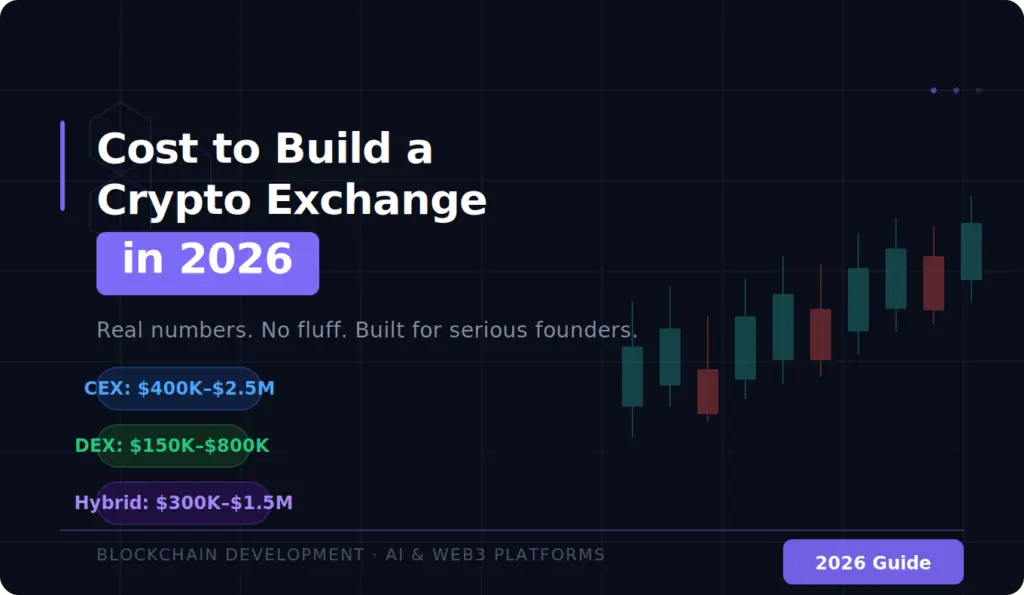
A CEX controls custody of user funds and operates a centralized order book. Think Binance, Coinbase, or Kraken. These are the most expensive to build due to regulatory requirements, security obligations, and the engineering complexity of a high-throughput matching engine.
2026 Cost Range: $400,000 – $2,500,000+
2. Decentralized Exchange (DEX)
A DEX runs on smart contracts. Users retain custody of their funds. Uniswap, dYdX, and Curve are examples. These require deep blockchain engineering expertise but eliminate some of the regulatory burden.
2026 Cost Range: $150,000 – $800,000
3. Hybrid Exchange
Combines elements of both. Non-custodial wallet management with a centralized matching engine for performance. Increasingly popular for institutional DeFi.
2026 Cost Range: $300,000 – $1,500,000
Core Cost Components: What You’re Actually Paying For
1. Matching Engine — $80,000 to $300,000
The matching engine is the heart of any CEX. It processes buy and sell orders in real time. At scale, you need sub-millisecond latency, the ability to handle thousands of orders per second, and zero tolerance for errors.
Building a production-grade matching engine from scratch in 2026 typically requires 2–4 senior engineers over 3–6 months. Off-the-shelf solutions exist but introduce vendor lock-in and scalability ceilings you’ll hit at the worst moment.
Key cost drivers:
- Throughput requirements (transactions per second)
- Support for order types (market, limit, stop-loss, OCO)
- Multi-asset vs. single-pair support
- Latency SLA requirements
2. Wallet & Custody Infrastructure — $60,000 to $250,000
For CEX platforms, this is often the most underestimated cost. You need hot wallet management (for liquidity), cold storage architecture (for security), and multi-signature signing protocols.
In 2026, most high-ticket exchanges integrate with institutional custodians like Fireblocks or Copper as a baseline, but still need custom integration work and proprietary risk management logic built on top.
Key cost drivers:
- Number of supported blockchains and tokens
- MPC (multi-party computation) vs. traditional multi-sig
- HSM (hardware security module) integration
- Automated sweep and rebalancing logic
3. Blockchain Integration — $40,000 to $180,000
Each blockchain you support requires its own node infrastructure, transaction monitoring, deposit detection, and withdrawal processing. Bitcoin and Ethereum are table stakes. But if you’re supporting Solana, Avalanche, Arbitrum, or custom EVM chains, each adds engineering overhead.
2026 reality: Gas abstraction, EVM compatibility layers, and cross-chain bridge integrations have added complexity — and cost — that didn’t exist three years ago.
4. Trading Interface (Frontend) — $50,000 to $200,000
Your trading UI is how users judge your exchange in the first 30 seconds. In 2026, the bar is high. Users expect TradingView chart integrations, real-time order book depth, mobile-responsive layouts, and one-click trading.
This isn’t the place to cut corners if you’re targeting professional or institutional traders.
Key cost drivers:
- Pro trader interface vs. simplified retail UI
- Mobile app (iOS + Android)
- Dark/light mode, accessibility compliance
- Custom charting vs. TradingView white-label
5. Admin Dashboard & Back Office — $30,000 to $100,000
Every serious exchange needs a command center: user management, KYC status, transaction monitoring, fee configuration, risk controls, and compliance reporting. This is invisible to users but critical for operations.
6. KYC/AML Integration — $20,000 to $80,000
Compliance is non-negotiable in 2026. Most exchanges integrate third-party KYC providers (Sumsub, Jumio, Onfido) plus AML transaction screening (Chainalysis, Elliptic). Integration costs vary significantly based on your compliance scope — retail onboarding in one jurisdiction vs. global institutional-grade compliance are very different engineering projects.
Ongoing cost note: KYC/AML is also a significant recurring cost. Budget $0.50–$5.00 per verified user depending on your provider and compliance tier.
7. Liquidity — The Cost Nobody Talks About
Here’s the cost that sinks most exchanges: liquidity.
An exchange without liquidity is an empty restaurant. You have two options in 2026:
Market Maker Agreements: Established market makers (Wintermute, GSR, Jump) will provide liquidity in exchange for fee rebates, flow access, or direct payment. Expect to commit $50,000–$500,000+ in incentives or deposit requirements to attract serious market makers at launch.
AMM/Liquidity Mining: For DEX platforms, you’ll need to bootstrap liquidity pools, often through token incentive programs. This has real cost in token dilution even if it doesn’t show up as a line item on a dev invoice.
Most founders budget for the technology and forget the liquidity. Don’t make that mistake.
Full Cost Breakdown Table
| Component | MVP / Lean | Production-Grade | Enterprise |
|---|---|---|---|
| Matching Engine | $40,000 | $150,000 | $300,000+ |
| Wallet & Custody | $30,000 | $120,000 | $250,000+ |
| Blockchain Integration (3–5 chains) | $30,000 | $80,000 | $180,000+ |
| Trading UI (Web) | $25,000 | $80,000 | $150,000+ |
| Mobile Apps (iOS + Android) | $20,000 | $70,000 | $120,000+ |
| Admin Dashboard | $15,000 | $45,000 | $100,000+ |
| KYC/AML Integration | $15,000 | $40,000 | $80,000+ |
| Security Audits | $20,000 | $60,000 | $150,000+ |
| Infrastructure (Year 1) | $24,000 | $60,000 | $200,000+ |
| Total Estimate | $220,000 | $705,000 | $1,530,000+ |
Note: Liquidity costs, licensing fees, and ongoing ops are excluded from the above.
Build vs. Buy vs. White-Label: The 2026 Decision Framework
White-Label Solutions: $30,000 – $150,000
White-label crypto exchange software (AlphaPoint, Openware, B2Broker) lets you launch faster at lower upfront cost. But you’re buying someone else’s architecture, and you’ll pay for it in:
- Revenue share or licensing fees (ongoing)
- Limited customization
- Shared infrastructure risk
- Dependence on the vendor’s roadmap
White-label works if you’re testing a market hypothesis or launching a niche exchange in a regulated market where speed matters more than differentiation.
Custom Build: $400,000 – $2,500,000+
Custom development is the right choice when:
- You have a genuine technical differentiation (proprietary matching algorithm, novel order types, unique liquidity model)
- You’re targeting institutional clients who require specific SLAs
- You’re building in a jurisdiction with specific compliance requirements
- You intend to scale to significant volume (>$100M/month)
Hybrid Approach: The Smart Middle Ground
Most serious 2026 exchanges are adopting a hybrid strategy: use battle-tested open-source components for commodity functionality (wallet management, basic order routing) and invest custom engineering where it actually matters for your moat.
Hidden Costs That Derail Budgets
Security Audits — Non-Negotiable
Before you launch, you need at minimum:
- Smart contract audits (if DEX): $20,000–$80,000 per audit
- Penetration testing: $15,000–$50,000
- Ongoing bug bounty program: $5,000–$50,000+ per quarter
Skipping this is existential risk. Exchanges have lost hundreds of millions to exploits that a proper audit would have caught.
Regulatory Licensing
Depending on your target markets, licensing costs vary dramatically:
- US MSB Registration: $5,000–$20,000 (plus state-by-state money transmitter licenses: $500,000+ total for full US coverage)
- EU MiCA Compliance: $100,000–$500,000 in legal and structural costs
- Singapore MAS License: $50,000–$200,000
- Offshore Jurisdictions (Seychelles, BVI): $10,000–$50,000
Team Costs Post-Launch
Your exchange doesn’t run itself. Expect to budget for:
- 1–2 DevOps/infrastructure engineers: $150,000–$300,000/year
- 1 compliance officer: $80,000–$150,000/year
- Customer support team: $60,000–$120,000/year
- Security monitoring: $30,000–$80,000/year
What Determines Your Final Number
After working with dozens of crypto and AI platforms, the variables that most predictably drive cost are:
1. Number of supported assets and chains Each new blockchain multiplies your infrastructure, integration, and ongoing maintenance burden. Start narrow.
2. Regulatory scope Building for a single jurisdiction with clear regulation is far cheaper than a global compliance matrix. Choose your initial market deliberately.
3. Performance requirements An exchange built for $1M/month in volume has fundamentally different engineering requirements than one targeting $1B/month. Don’t over-engineer for scale you haven’t earned, but don’t build ceilings you’ll hit at the worst time.
4. Team location and structure Fully US-based teams: $150–$300/hour blended rate Eastern European or LATAM teams: $50–$120/hour blended rate Mixed (US leadership + offshore execution): $80–$150/hour blended rate
In 2026, the quality gap between top offshore and US engineers has narrowed significantly, but coordination overhead is real. The best outcomes come from hybrid teams with strong technical leadership regardless of location.
5. IP ownership vs. vendor dependency Decisions made in month one about architecture, vendor integrations, and data ownership compound for years. Build for exit optionality from day one.
How to Validate Your Budget Before You Commit
Before signing any development contract, do these three things:
1. Define your MVP ruthlessly Your exchange doesn’t need to support 500 trading pairs, three languages, and a copy-trading feature on day one. What is the smallest version that validates your core thesis?
2. Get a technical architecture review A 2–3 day paid engagement with a senior blockchain architect (not a sales call with a dev shop) to review your requirements and validate your build plan is worth every dollar. It routinely saves 10–20% of total project cost.
3. Model your unit economics Know your target take rate, projected volume, and customer acquisition cost before you finalize your budget. A $500,000 exchange that never reaches $50M/month in volume is a bad investment. A $2M exchange that captures 0.1% of a $10B/month market generates $10M annually.
2026 Market Context: What’s Changed
The crypto exchange landscape in 2026 has shifted in ways that directly impact build decisions:
Institutional demand is the growth vector. Retail crypto trading volumes have stabilized. The real growth is institutional — hedge funds, family offices, and corporate treasuries. Exchanges that can meet institutional requirements (prime brokerage, sophisticated reporting, API reliability guarantees) command premium positioning.
Compliance is a competitive advantage, not a cost. Post-MiCA implementation in Europe and evolving US regulatory clarity, exchanges with clean compliance architecture are attracting institutional capital that previously sat on the sidelines. This has made compliance engineering a product feature, not just a legal checkbox.
AI-powered order routing and risk management has moved from experimental to expected in tier-one platforms. Integrating AI for anomaly detection, dynamic fee optimization, and predictive liquidity management adds $50,000–$200,000 to a build but creates measurable defensibility.
Cross-chain is table stakes. In 2026, single-chain exchanges are niche products. Multi-chain architecture from day one — even if you’re only supporting two or three networks at launch — dramatically reduces technical debt and opens partnership opportunities.
Questions to Ask Any Development Partner
If you’re evaluating dev shops or agencies for your exchange build, these questions separate serious partners from order-takers:
- Can you show us a matching engine you’ve deployed in production and its throughput benchmarks?
- How do you handle wallet security architecture — what’s your cold/hot storage ratio recommendation and why?
- What’s your approach to chain reorganization handling for deposit detection?
- How do you structure smart contract audits — internal, external, or both?
- What does your post-launch support model look like for critical infrastructure?
If they can’t answer these fluently, keep looking.
The Bottom Line
Building a crypto exchange in 2026 is expensive because it should be. You’re building financial infrastructure that users will trust with real money. The cost of doing it wrong — in lost funds, regulatory action, or reputational damage — dwarfs any savings from cutting corners.
Here’s the real question: Is this the right investment for your specific opportunity?
A well-built exchange targeting a real, underserved market with a credible liquidity strategy can generate returns that justify even a $2M build. A poorly scoped project chasing a crowded market will underperform regardless of how little you spent.
The founders who win in this space are the ones who understand the full cost picture, build with institutional-grade thinking from day one, and choose development partners with verifiable production experience — not the ones who found the cheapest quote.
Looking to build a crypto exchange or Web3 platform that scales? We help startups and enterprises design, build, and launch AI and blockchain products built for performance, compliance, and long-term growth.